How Fumio Kishida Changed Japan’s Foreign Policy: The Legacy of His Indo-Pacific Strategy
Introduction
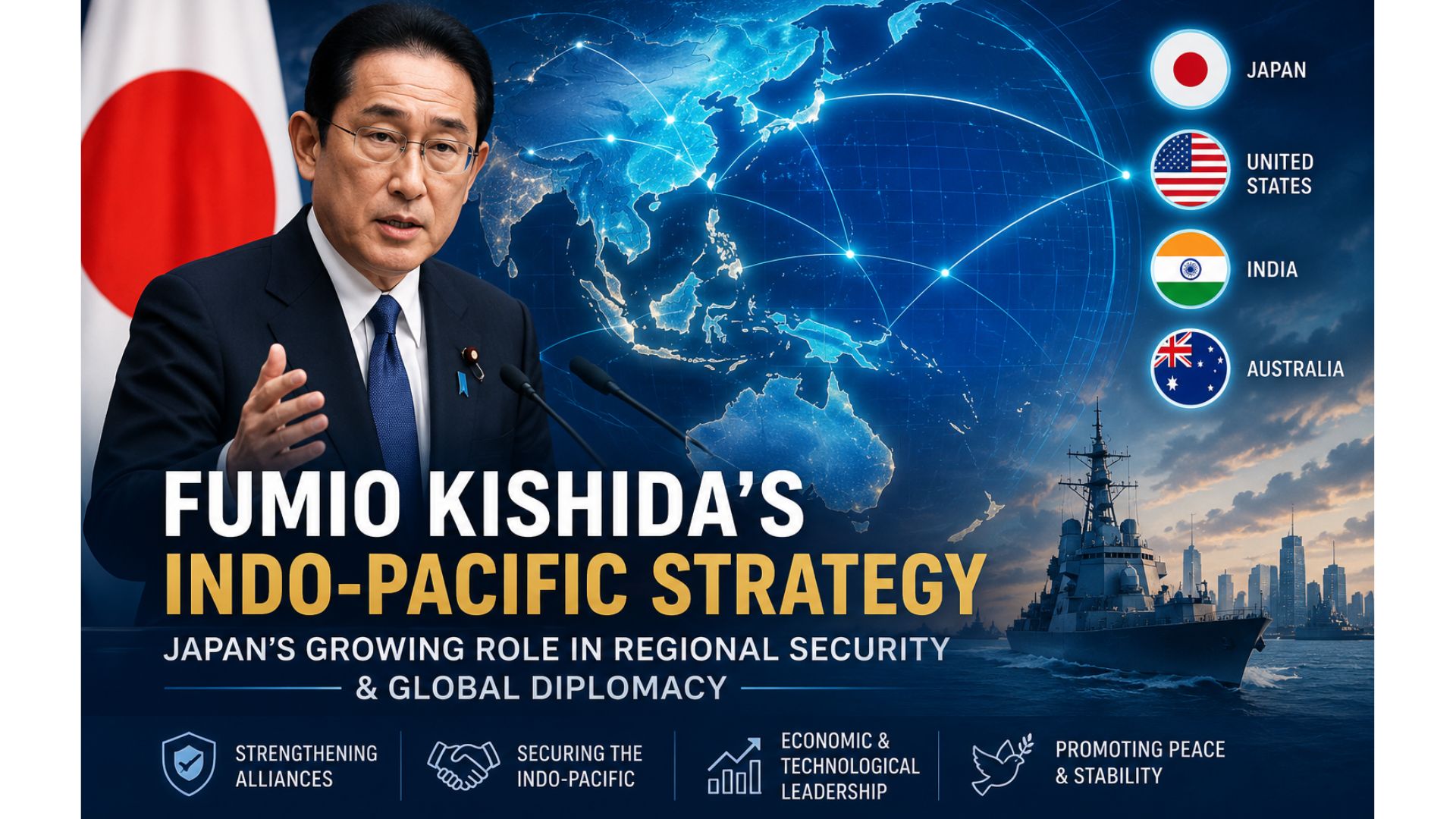
When historians examine Japan’s foreign policy in the 2020s, the leadership of Fumio Kishida will likely stand out as a defining period of strategic transformation. Although Japan had already begun adapting to a changing security environment before Kishida took office in 2021, his government accelerated many of the country’s most significant diplomatic and security initiatives.
During his tenure, Japan expanded its vision for a Free and Open Indo-Pacific, strengthened strategic partnerships with democratic nations, increased defense spending, elevated economic security as a national priority, and played a larger role in addressing global challenges. Rather than abandoning Japan’s traditional diplomatic principles, Kishida modernized them for an era marked by growing geopolitical competition, technological rivalry, and supply-chain vulnerabilities.
His legacy is not simply about military modernization or alliance-building. It is about repositioning Japan as a proactive global actor capable of influencing the future of the Indo-Pacific region.
Quick Facts About Fumio Kishida
- Full Name: Fumio Kishida
- Position: Prime Minister of Japan (2021–2024)
- Key Foreign Policy Focus: Free and Open Indo-Pacific (FOIP)
- Major Alliances: United States, India, Australia, Europe
- Key Initiatives: Defense reforms, economic security, Quad cooperation
- Notable Event: G7 Hiroshima Summit 2023
Inside this article:
- Who Is Fumio Kishida?
- What Was Japan’s Foreign Policy Before Kishida?
- The Free and Open Indo-Pacific (FOIP) Vision Explained
- How Kishida Strengthened the U.S.-Japan Alliance
- The Quad Partnership and Japan’s Regional Influence
- Kishida’s China Policy: Balancing Cooperation and Security
- Japan’s Biggest Defense Reforms Under Kishida
- Economic Security and Supply Chain Resilience
- The G7 Hiroshima Summit and Global Leadership
- Japan’s Expanding Role in Global Diplomacy
- Major Criticisms of Kishida’s Foreign Policy
- What Is Fumio Kishida’s Foreign Policy Legacy?
- Frequently Asked Questions (FAQs)
- Conclusion: How Kishida Changed Japan’s Place in the World
Who Is Fumio Kishida?
Fumio Kishida Foreign Policy Timeline
- 2021 – Became Prime Minister of Japan
- 2022 – Announced major defense policy reforms
- 2023 – Introduced updated FOIP strategy
- 2023 – Hosted the G7 Hiroshima Summit
- 2024 – Left office after overseeing major strategic changes
Fumio Kishida served as Japan’s Prime Minister from October 2021 until 2024. Before becoming prime minister, he held several important government positions, including Foreign Minister.
Kishida was often viewed as a moderate and consensus-driven leader. However, despite his reputation for caution, his administration presided over some of the most consequential foreign and security policy changes in modern Japanese history.
His leadership coincided with several major global developments:
- Intensifying competition between the United States and China
- Russia’s invasion of Ukraine
- Rising concerns about Taiwan Strait stability
- Increasing North Korean missile activity
- Growing economic and technological competition
These developments forced Japan to rethink many of its traditional assumptions about security and diplomacy.
Japan’s Foreign Policy Before Kishida
To understand Kishida’s impact, it is important to examine the foundation he inherited.
For decades after World War II, Japan focused primarily on economic growth while maintaining a relatively restrained military posture. Security was largely anchored by the U.S.-Japan alliance, while Japanese diplomacy emphasized economic cooperation, development assistance, and international institutions.
Former Prime Minister Shinzo Abe had already begun expanding Japan’s strategic role through the Free and Open Indo-Pacific concept and stronger security partnerships. Kishida inherited these initiatives but expanded and institutionalized many of them.
Rather than introducing an entirely new doctrine, Kishida refined and accelerated Japan’s strategic evolution.
The Free and Open Indo-Pacific Vision
One of the most important elements of Kishida’s foreign policy legacy is his expansion of the Free and Open Indo-Pacific (FOIP) strategy.
In 2023, Kishida unveiled a new FOIP plan that outlined four major pillars of cooperation:
- Principles for peace and prosperity
- Addressing shared regional challenges
- Multi-layered connectivity
- Expanding security cooperation from sea to air domains
The initiative emphasized cooperation rather than confrontation while promoting international law, freedom of navigation, infrastructure development, and regional connectivity. Japan also increased its engagement with developing nations across Asia, Africa, and other parts of the Global South.
Unlike military alliances, FOIP was designed as a broad strategic framework connecting diplomacy, trade, development assistance, and security cooperation.
Strengthening the U.S.-Japan Alliance
The U.S.-Japan alliance remained the cornerstone of Kishida’s foreign policy.
Under his leadership, cooperation expanded beyond traditional defense arrangements. Japan and the United States increased collaboration in:
- Cybersecurity
- Artificial intelligence
- Semiconductor supply chains
- Defense technology
- Economic security
- Maritime security
Kishida’s government viewed the alliance not only as a defense partnership but as a comprehensive strategic relationship capable of addressing emerging challenges across multiple domains. Analysts widely regard this period as one of the strongest phases in modern U.S.-Japan relations.
The Rise of the Quad Partnership
Another major feature of Kishida’s foreign policy was the strengthening of the Quad.
The Quad consists of:
- Japan
- India
- United States
- Australia
While often discussed in security terms, the Quad’s agenda expanded significantly during Kishida’s tenure.
Areas of cooperation included:
- Maritime security
- Infrastructure development
- Emerging technologies
- Health initiatives
- Climate resilience
- Supply-chain security
Japan also worked closely with India, viewing New Delhi as an indispensable partner in maintaining a stable Indo-Pacific order. Kishida’s 2023 visit to India highlighted the central role of India within Japan’s strategic vision.
Kishida’s Approach to China
Managing relations with China represented one of the most difficult challenges of Kishida’s premiership.
China remains one of Japan’s largest trading partners. At the same time, concerns persisted regarding:
- Military activity near Japanese territory
- Taiwan Strait stability
- East China Sea disputes
- Economic coercion
- Cybersecurity risks
Kishida pursued a dual-track strategy.
On one hand, Japan continued dialogue and economic engagement with Beijing. On the other hand, Japan strengthened its defenses and expanded cooperation with allies and partners.
This balancing act reflected a broader strategy aimed at reducing risks while avoiding unnecessary escalation.
Defense Reforms and Security Transformation
Perhaps the most visible aspect of Kishida’s legacy involves defense policy.
Historically, Japan maintained relatively modest defense spending compared with many major powers. Under Kishida, Japan announced plans to significantly increase defense spending and strengthen its deterrence capabilities.
Key initiatives included:
- Modernization of Self-Defense Forces
- Improved missile defense systems
- Cybersecurity capabilities
- Space security programs
- Counterstrike capabilities
- Enhanced interoperability with allies
These reforms were largely driven by concerns about regional security developments involving China, North Korea, and Russia. Observers often describe these decisions as among the most significant security changes in postwar Japanese history.
Economic Security Becomes a National Priority
Kishida also helped elevate economic security to the center of Japan’s foreign policy.
The COVID-19 pandemic and global geopolitical tensions exposed vulnerabilities in international supply chains. Japan responded by pursuing policies designed to reduce strategic dependencies and strengthen resilience.
Priority areas included:
- Semiconductors
- Advanced manufacturing
- Rare earth materials
- Critical infrastructure
- Digital technologies
- Energy security
Rather than separating economics and security, Kishida’s government increasingly treated them as interconnected policy areas.
This approach has continued to influence Japanese policymaking even after his departure from office.
The G7 Hiroshima Summit
One of the defining moments of Kishida’s international leadership was the 2023 G7 Summit in Hiroshima.
Hosting the summit in Hiroshima carried deep symbolic significance due to the city’s history as the site of the first atomic bombing during World War II.
The summit addressed numerous global issues, including:
- Ukraine
- Economic security
- Food security
- Climate challenges
- International law
- Global development
Kishida used the summit to emphasize the importance of a rules-based international order and strengthen cooperation among democratic nations. The event also elevated Japan’s diplomatic profile on the global stage.
Expanding Partnerships Beyond Asia
Although the Indo-Pacific remained central to Kishida’s strategy, his foreign policy extended beyond Asia.
Japan deepened relations with:
- European Union members
- United Kingdom
- NATO partners
- Canada
- Emerging economies in the Global South
These partnerships reflected Japan’s growing recognition that regional security and global stability are increasingly interconnected.
The result was a broader diplomatic network capable of supporting Japan’s strategic objectives across multiple regions.
Criticisms of Kishida’s Foreign Policy
No foreign policy strategy is without critics.
Some observers argued that defense spending increases placed additional pressure on Japan’s fiscal position.
Others worried that closer alignment with Western security frameworks could increase tensions with China.
Some analysts also questioned whether Japan could sustain its expanded international commitments over the long term.
Nevertheless, even many critics acknowledge that Kishida significantly accelerated Japan’s strategic transformation.
The Lasting Impact of Kishida’s Legacy
The most important measure of a foreign policy legacy is whether its influence continues after a leader leaves office.
In Kishida’s case, many of his initiatives appear likely to shape Japanese policy for years to come.
His government:
- Expanded the FOIP framework
- Strengthened strategic partnerships
- Elevated economic security
- Modernized defense planning
- Increased Japan’s diplomatic visibility
These changes have become embedded in Japan’s broader strategic outlook.
Future leaders may adjust priorities and implementation, but the overall direction established during the Kishida era is likely to remain influential.
Frequently Asked Questions
What is Fumio Kishida best known for in foreign policy?
Kishida is best known for expanding Japan’s Free and Open Indo-Pacific strategy, strengthening alliances, increasing defense spending, and promoting economic security.
What is the Free and Open Indo-Pacific strategy?
FOIP is Japan’s vision for a region based on international law, open trade, connectivity, freedom of navigation, and peaceful cooperation among nations.
Did Kishida change Japan’s defense policy?
Yes. His government approved major defense reforms, increased spending, and introduced new capabilities aimed at strengthening deterrence and national security.
How did Kishida approach China?
Kishida combined diplomatic engagement with stronger security measures, seeking to balance economic cooperation with national security concerns.
Why is Kishida’s foreign policy legacy important?
His policies helped redefine Japan’s role in global affairs and positioned the country as a more active participant in shaping the future of the Indo-Pacific region.
Conclusion: Fumio Kishida’s Lasting Impact on Japan’s Foreign Policy
Fumio Kishida’s foreign policy legacy reflects a period of significant change for Japan. His administration strengthened alliances, expanded the Free and Open Indo-Pacific vision, modernized security policy, and elevated economic resilience as a strategic priority.
Rather than pursuing dramatic ideological shifts, Kishida focused on practical adaptation to a rapidly changing world. The result was a foreign policy framework that combined diplomacy, security, economic strategy, and international cooperation.
Whether viewed from Tokyo, Washington, New Delhi, or other capitals across the Indo-Pacific, Kishida’s tenure will likely be remembered as a period when Japan stepped forward as a more confident, connected, and influential global actor.