Term Insurance vs Health Insurance: Which One Do You Need?
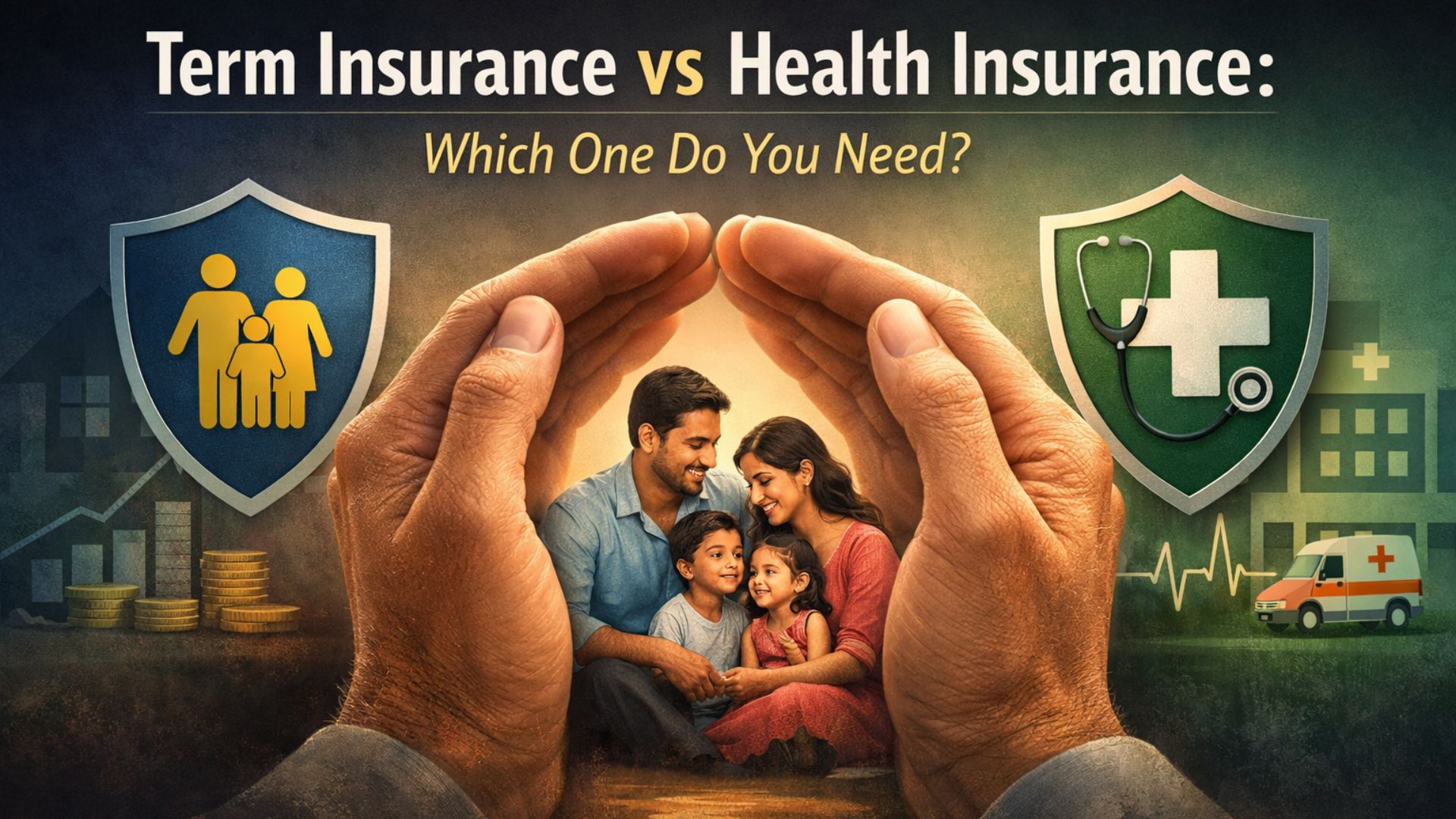
Term insurance vs health insurance — the two sound similar, but they protect you in completely different ways. Term insurance secures your family’s financial future if something happens to you, while health insurance shields you from unexpected medical bills. Yet many people buy the wrong one first — or don’t buy enough of either. In this article, you’ll clearly understand how each policy works, what they actually cover, and how to choose the right protection at the right time.
This guide is written especially for Indian readers, because insurance rules, costs, and tax benefits (like Sections 80C and 80D) work a little differently here compared to other countries.
In This Article:
- What Is Term Insurance and How Does It Work?
- What Is Health Insurance and Why Is It Essential?
- Term Insurance vs Health Insurance: Key Differences Explained
- Which Should You Buy First — and at What Age?
- Costs, Premiums, Riders, and Tax Benefits Compared
- Real-Life Scenarios: When Each Policy Actually Helps
- Common Questions About Term vs Health Insurance
- Conclusion
1. What Is Term Insurance and How Does It Work?
If someone depends on your income — your spouse, parents, or children — term insurance is like a financial safety net 🛡️. It doesn’t build savings, it doesn’t give yearly bonuses, and there’s no maturity benefit. Instead, it does one powerful thing: if you’re not around, it replaces your income so your family doesn’t struggle.
How it works is simple:
You pay a small premium every year for a fixed “term” — say 20, 30, or 40 years. If something happens to you during that period, your family receives the full “sum assured” (for example, ₹1 crore). If you outlive the term, the policy ends — just like paying for car insurance or home insurance.
Many people misunderstand this and say, “But nothing comes back if I survive!”
The truth is: that’s exactly why it’s affordable. Because it isn’t mixing insurance with investment.
Why people choose term insurance
- Guarantees a large coverage at a low cost
- Protects long-term goals like children’s education or home loans
- Gives peace of mind during high-responsibility years (30s–50s)
A quick mini case
Ravi, 32, earns ₹60,000 per month and has a home loan plus two small kids. He buys a ₹1 crore term plan for around ₹900 per month. Five years later, if something unexpected happens, his family would receive enough money to clear debts, continue schooling, and live without panic. Without term insurance, they would be dependent on relatives or loans.
Who should consider it first?
- Anyone with dependents
- People with loans
- Primary earners in the family
One smart thumb rule:
Your term cover should be 10–15 times your annual income.
Term insurance isn’t emotional — it’s mathematical. It ensures life doesn’t stop for your family, even if yours does.
2. What Is Health Insurance and Why Is It Essential?
If term insurance protects your family after you’re gone, health insurance protects you while you’re living. With medical costs rising faster than salaries, a single hospital bill can wipe out years of savings.
Health insurance pays for:
- Hospitalization and surgeries
- Medicines and tests
- Day-care procedures
- Emergency treatments
Depending on the plan, it can also include maternity care, critical illness coverage, and cashless hospitalization.
Why it matters so much 💡
People often believe “I’m healthy — why should I buy now?”
But insurance isn’t bought for today. It’s bought for the unknown future — and premiums increase with age.
A 28-year-old may get a ₹5–10 lakh health plan at a very reasonable premium. The same plan at 45 can cost double — and sometimes comes with medical tests and exclusions.
Mini story
Neha, 29, never bothered with health insurance because she rarely fell sick. One sudden appendicitis surgery cost ₹1.8 lakh. She had to swipe credit cards, take help from friends, and spend months repaying. After that, she bought insurance — but by then the premium was higher and her condition became “pre-existing”, which limited coverage initially.
Lesson: Buy when you’re healthy — not when hospitals become unavoidable.
Key benefits people overlook
- Protects savings and emergency funds
- Offers tax benefits
- Covers lifestyle diseases that are increasingly common
- Reduces stress during medical emergencies
Health insurance isn’t a luxury anymore. It’s part of a responsible financial plan — just like saving and investing.
Health insurance protects savings, reduces stress, and helps you focus on recovery. For a complete roadmap to wellness, including nutrition, exercise, and mental health, explore our Health & Wellness Guide.
3. Term Insurance vs Health Insurance: Key Differences Explained
Both sound like “insurance”, but they solve two completely different problems. Understanding the distinction helps you decide wisely — not emotionally.
Core difference (simple version)
- Term insurance → Protects your family’s future income
- Health insurance → Protects your present savings
Coverage comparison
- Term insurance pays a lump sum on death during the policy term.
- Health insurance pays medical bills while you’re alive and hospitalized.
Premiums
- Term premiums are relatively low because there is no maturity value.
- Health premiums rise with age and medical risks.
Benefit timing
- Term benefit → one-time payout to nominees.
- Health benefit → multiple claims during life (within the sum insured).
Example to make it clearer
Imagine Sunita earns ₹12 lakh per year. She has term insurance of ₹1.5 crore and a family health plan of ₹10 lakh.
- If she gets hospitalized for dengue — health insurance handles the bill.
- If something tragic happens — term insurance ensures her family’s future isn’t shattered.
Both policies serve different roles, and one cannot replace the other.
Quick side-by-side summary
- You can live without term insurance only if nobody depends on you.
- You can’t safely live without health insurance — because illness doesn’t ask who depends on you.
In short:
Term insurance protects dreams.
Health insurance protects savings.
Together, they protect your life’s foundation.
4. Which Should You Buy First — and at What Age?
This is the question almost everyone asks: between term insurance vs health insurance, which one should I buy first? The honest answer depends on your life stage — but there is a simple framework that works for most people.
Step 1: Protect yourself from hospital bills first
Medical emergencies can happen anytime — child, student, working professional, homemaker, or retiree. A single hospitalization can drain your savings and push you into debt. That’s why a basic health insurance plan should usually come first.
Even if your company provides coverage, remember:
- Employer insurance ends when you resign or change jobs
- Coverage is often limited (₹2–3 lakh)
- Claims from chronic illnesses may impact promotions or transfers quietly
A personal policy stays with you — job or no job.
Step 2: Buy term insurance when someone depends on your income
The moment you have dependents or loans, term insurance becomes essential.
These situations typically trigger it:
- You get married
- You take a home loan
- You have children
- You support aging parents
If nobody depends on your income yet, you can delay term insurance. But once responsibilities arrive, it should be non-negotiable 🛡️.
Why buying early is smarter
Premiums for both policies increase with age. But the difference is especially sharp for term insurance.
Mini example:
- Rohit buys term insurance at 27 — ₹1 crore cover for ₹9,000 per year
- Same plan at 37 — ₹16,000 to ₹18,000 per year
- At 47 — either rejected or extremely costly
Buying early locks the premium for the entire term.
A simple order most financial planners recommend
1️⃣ Health insurance — build medical safety first
2️⃣ Term insurance — once responsibilities appear
3️⃣ Critical illness riders — to cover income loss during long diseases
This sequence ensures that sickness doesn’t break your savings, and death doesn’t break your family’s future. Both policies work together — not against each other.
5. Costs, Premiums, Riders, and Tax Benefits Compared
When people compare term insurance vs health insurance, they often look only at premiums — not value. The cheaper plan isn’t always the better plan. Understanding what you’re actually paying for makes the decision clearer.
How premiums are calculated
Term insurance considers:
- Age
- Health conditions
- Smoking habits
- Policy term and sum assured
Because the company only pays out in the event of death, it can offer very high coverage at affordable rates.
Health insurance considers:
- Age and city of residence
- Pre-existing diseases
- Lifestyle and hospitalization trends
- Room rent limits and add-ons
Premiums may increase every few years as you move to a higher age bracket.
Riders — small add-ons that make policies smarter
Riders allow you to customize coverage without buying separate plans.
Common term insurance riders:
- Accidental death benefit
- Critical illness rider
- Waiver of premium (premium stops if you become disabled)
Useful health insurance add-ons:
- No-claim bonus boosters
- OPD coverage
- Room rent upgrade
- Maternity cover
Choose only what you need — unnecessary riders increase cost without adding value.
Tax benefits (a bonus, not the main reason)
- Section 80C → Term insurance premiums
- Section 80D → Health insurance premiums
While tax benefits are attractive, they shouldn’t drive the decision. Insurance is protection first — savings later.
Mini example
Amit and Pooja spend ₹20,000 annually on health insurance and ₹10,000 on term insurance. Their friends laugh and call it “wasted money.” Two years later, Pooja’s surgery cost ₹2.4 lakh — fully covered. Suddenly, that “wasted money” looked like the smartest financial decision they ever made.
Insurance feels expensive — until the day it saves you.
6. Real-Life Scenarios: When Each Policy Actually Helps
Sometimes tables and charts don’t explain things as clearly as real life. So let’s see how term insurance vs health insurance plays out in everyday situations.
Scenario 1: Hospital emergency
Arjun slips while playing cricket and fractures his leg. Surgery and hospitalization cost ₹1.2 lakh.
👉 Health insurance pays.
👉 Arjun’s savings remain intact.
👉 Life continues smoothly.
Scenario 2: Long-term illness
Meena develops a critical illness and requires ongoing treatment costing ₹30,000 per month.
👉 Health insurance covers major hospitalization
👉 Critical illness rider (if taken) provides a lump sum to compensate income loss
👉 Term insurance does not apply here, because she is alive.
Scenario 3: Primary earner passes away
Rajesh, the only earning member, dies unexpectedly in an accident.
👉 Term insurance pays the full sum assured
👉 His spouse clears the home loan, children’s education continues
👉 Health insurance does not play any role here.
Scenario 4: No insurance at all
Sanjay avoided buying both policies, thinking it was “wasteful”. After a sudden heart procedure costing ₹4.5 lakh, he used credit cards and loans. Later, when he tried to buy insurance, premiums were higher and exclusions applied. A second health issue nearly ruined the family financially.
Insurance isn’t about fear. It’s about reducing risk to zero where possible.
Key takeaway from all scenarios
- Health insurance is for now
- Term insurance is for what if
One protects the journey. The other protects the destination. And real peace of mind comes only when both are in place.
Common Questions About Term vs Health Insurance
❓Do I really need both term insurance and health insurance?
Yes — because they solve different problems. Health insurance handles medical expenses. Term insurance replaces income so your family doesn’t suffer financially.
❓Is term insurance a good investment?
No — and that’s exactly why it works. It’s pure protection, not a savings plan. If you want returns, invest separately in mutual funds or other instruments.
❓What happens if I don’t claim anything?
For term insurance, nothing is paid — but your family stayed protected for the entire term.
For health insurance, your no-claim bonus may increase the coverage in many plans.
❓Can I rely only on company-provided health insurance?
It’s risky. Employer policies may end when you switch jobs or retire, and coverage limits are often low. A personal policy gives lifelong protection.
❓How much coverage should I take?
– Term insurance: 10–15 times your annual income
– Health insurance: At least ₹5–10 lakh for individuals, more for families and metro cities
❓What if I buy insurance late?
Premiums rise, exclusions increase, and sometimes policies get rejected. Buying early is cheaper and safer.
❓Are critical illness plans necessary?
They are helpful if your family depends on your income. They provide a lump sum to manage expenses during long treatments when income stops.
Conclusion
When you look closely at term insurance vs health insurance, you’ll notice something simple but powerful: they aren’t competitors. They are teammates. One protects the people you love when you’re not there, and the other protects you from financial shocks while you’re alive.
Most families get into trouble not because they don’t earn enough — but because they are unprepared for emergencies. A well-chosen insurance plan is like a silent guardian. You hope you never need it, but when life surprises you, it quietly does its job.
Final, practical checklist 👍
Before you close this article, ask yourself:
- If I’m hospitalized tomorrow, will my savings survive?
- If something happens to me, will my family be financially stable?
- Are my policies enough to match my income, lifestyle, and future plans?
If any answer feels uncertain, it’s time to review your coverage — calmly, not fearfully.
A short closing example
Vikas and Shalini decided to prioritize vacations and gadgets over insurance. When Shalini fell seriously ill, the hospital bill ate their emergency fund in three days. Later, when Vikas passed away in an accident, their family had no financial backup. Two simple policies could have changed everything.
Insurance doesn’t protect things. It protects people.
Want to continue learning? Check out our Finance & Investing Guide — a complete starter path to manage money smarter and start investing confidently.