Forex Broker Comparison 2026: Spreads, Commissions, Execution & Real Trading Costs
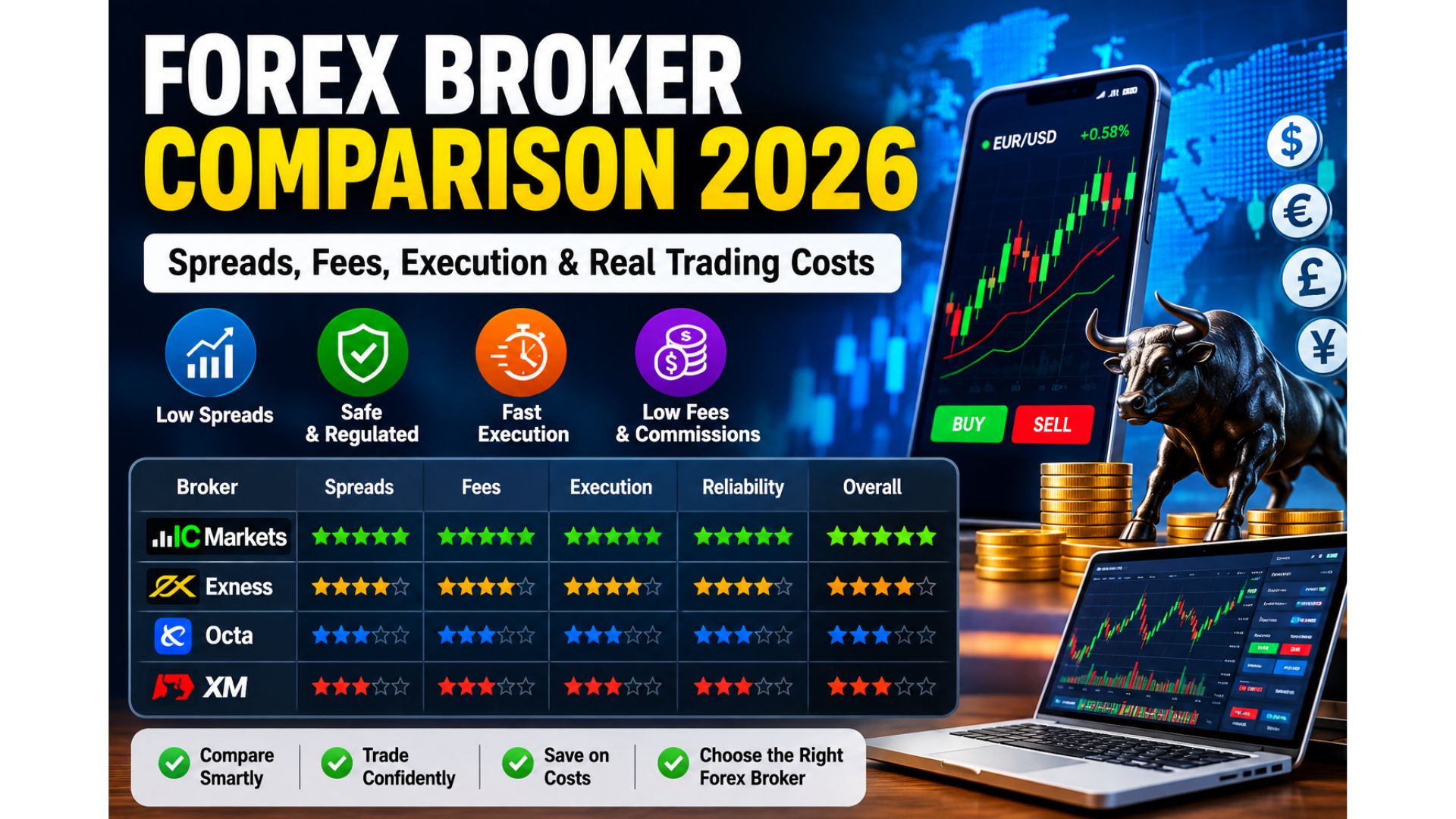
Choosing a forex broker in 2026 is not as simple as finding the broker advertising the lowest spread.
A broker may advertise spreads from 0.0 pips, while another may show a slightly higher spread but charge no separate commission. Once spreads, commissions, swaps, slippage and other trading costs are considered together, the cheaper option is not always the one that looks cheapest on the broker’s homepage.
This forex broker comparison explains what actually affects your trading cost, how to compare brokers properly, and what traders should check before opening a live account.
Risk warning: Forex and CFD trading involves significant risk and may not be suitable for every investor. Leverage can magnify both profits and losses. Never trade with money you cannot afford to lose.
In this article:
- How This Forex Broker Comparison Works
- What Actually Matters When Comparing Forex Brokers
- Why Slippage and Execution Matter
- Comparing Forex Brokers for Different Trading Styles
- IC Markets: Pricing, Platforms and Regulation
- How to Choose a Forex Broker
- Forex Broker Checklist Before You Deposit
- Forex Brokers for Scalping and Beginners
- Should You Use a Forex IB Link?
- Final Verdict
- Frequently Asked Questions
How This Forex Broker Comparison Works
This comparison does not rank brokers simply by their advertised minimum spread. I compare the factors that can materially affect a trader’s actual experience, including regulatory entity, average spreads, commissions, execution, slippage, financing costs, platform availability and account conditions.
Broker information can change, so readers should verify current pricing and legal terms directly with the broker before opening an account.
Forex Broker Comparison: What Actually Matters?
When comparing forex brokers, I recommend looking at six major areas:
| Factor | Why it matters |
|---|---|
| Spread | Affects the cost of entering and exiting trades |
| Commission | Important for raw-spread accounts |
| Slippage | Can increase the actual cost of execution |
| Swap/overnight fees | Important for positions held after the trading day |
| Execution | Can affect the price at which your order is filled |
| Regulation | Helps you understand which legal entity and rules apply |
The mistake many beginners make is comparing only the advertised spread.
A more useful question is:
How much will this broker actually cost me for my trading style?
1. Spread: The First Cost to Compare
The spread is the difference between the bid and ask price.
For example, if EUR/USD is quoted as:
Bid: 1.10000
Ask: 1.10010
the difference is 0.1 pip.
A smaller spread generally means a lower entry cost, but traders should understand the difference between a minimum spread and an average spread.
Minimum spread
This is the lowest spread the broker says may be available under suitable market conditions.
Average spread
This gives a better indication of typical pricing, although actual spreads can still change.
During major economic announcements or periods of low liquidity, spreads can widen considerably.
Therefore, don’t choose a broker simply because its website says:
“Spreads from 0.0 pips.”
The word “from” is important.
2. Commission: The Cost Hidden Behind Low Spreads
Raw-spread accounts often separate the trading cost into two components:
Spread + commission
For example, a broker could offer a very low EUR/USD spread while charging a commission for each standard lot traded.
Suppose the commission is:
$3.50 per lot per side
If the commission is $3.50 per standard lot per side, opening the position incurs $3.50 in commission and closing it incurs another $3.50, giving a $7 round-trip commission.
So the round-trip commission would be:
$7.00 per standard lot
The spread is additional.
This is why comparing a 0.0-pip account with a 0.8-pip commission-free account requires more than looking at the headline spread.
3. Raw Spread vs Standard Account
Most traders will encounter two common pricing models.
Raw Spread Account
A raw-spread account generally provides a tighter underlying spread while charging a separate commission.
This structure can be attractive to:
- Scalpers
- Day traders
- High-volume traders
- Algorithmic traders
- Expert Advisor users
Standard Account
A standard account generally incorporates the broker’s markup into the spread rather than charging a separate forex trading commission.
This can be easier to understand for beginners.
Which account is cheaper?
There is no universal answer.
The correct comparison is:
Total cost = spread cost + commission + applicable financing/other costs
Your trading frequency and position size determine which pricing model makes more sense.
4. Why Slippage Matters
Slippage occurs when your order is executed at a different price from the price you expected.
For example, you may attempt to buy EUR/USD at 1.10000, but your order could be filled at 1.10003.
That difference may appear small.
But if you trade frequently, repeated differences in execution can become meaningful.
Slippage can be influenced by:
- Market volatility
- Economic announcements
- Liquidity
- Order type
- Trading session
- Market conditions
This is particularly important for scalpers because they may make many trades while targeting relatively small price movements.
A broker comparison that discusses only spreads therefore does not tell the whole story.
5. Trading Costs Are Different for Different Traders
There is no single “cheapest forex broker” for every trader.
Consider three traders.
Trader A: Occasional trader
Trades a few times per month and holds positions for several days.
This trader may care more about:
- Regulation
- Platform
- Overnight financing
- Withdrawal conditions
- Ease of use
Trader B: Day trader
Makes several trades during the day.
This trader may place greater importance on:
- Spread
- Commission
- Execution
- Slippage
- Platform reliability
Trader C: Scalper
Makes many short-term trades.
This trader may pay particularly close attention to:
- Average spread
- Commission
- Execution
- Slippage
- Trading infrastructure
- Platform performance
Therefore, a broker that is suitable for one trader may not be suitable for another.
6. Example: Comparing the Real Cost
Let’s use a simplified example.
Imagine two hypothetical accounts.
| Cost | Broker A | Broker B |
|---|---|---|
| Spread | 0.1 pip | 0.8 pip |
| Commission | $7 round trip | $0 |
| Trading style | Raw spread | Standard |
| Other costs | Check broker | Check broker |
At first glance, Broker B appears to have the simpler pricing structure.
But suppose you trade a large number of positions.
The correct calculation is not:
“Which spread is smaller?”
Instead, calculate:
Total spread cost + total commissions + financing + other applicable costs
The result can be very different depending on your trade size and frequency.
7. What About IC Markets?
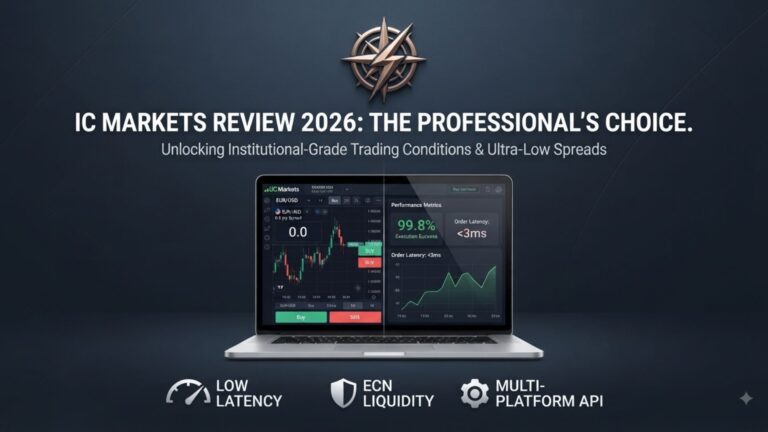
IC Markets is one broker that can be included in a forex broker comparison, particularly for traders interested in raw-spread pricing.
According to IC Markets’ currently published information, its Raw Spread account shows spreads from 0.0 pips, while its published average EUR/USD spread is approximately 0.1 pips and the MetaTrader Raw Spread commission is $3.50 per lot per side.
That means a trader should think about the pricing as:
EUR/USD spread + commission
rather than assuming that a 0.0-pip headline means zero trading cost.
Source: IC Markets official Raw Spread account information. Pricing, spreads and commissions can change, so verify the current conditions before opening an account.
IC Markets also states that its Raw Spread offering is designed with active traders, scalpers and Expert Advisor users in mind.
IC Markets trading platforms
IC Markets provides access to platforms including MetaTrader 4, MetaTrader 5 and cTrader, depending on the account and jurisdiction.
For traders who use automated strategies or Expert Advisors, platform compatibility can be an important part of the broker-selection process.
IC Markets regulation
This is an area where traders should pay close attention to the legal entity, rather than relying only on the broker’s brand name.
IC Markets Global states that IC and IC Markets Global are trading names of Raw Trading Ltd, which is regulated by the Seychelles Financial Services Authority (FSA) under Securities Dealer licence SD018.
The regulatory entity applicable to a client can depend on jurisdiction and account registration.
Therefore, always check the legal entity shown during your account-opening process and read the applicable legal and risk documents before depositing funds.
8. Is IC Markets the Cheapest Forex Broker?
It would be misleading to say that any broker is automatically the cheapest for everyone.
IC Markets’ published Raw Spread pricing can be attractive to traders who prioritize tight spreads and are comfortable with a separate commission.
But your actual trading cost depends on:
- Currency pair
- Position size
- Trading frequency
- Time of day
- Spread at execution
- Commission
- Overnight financing
- Slippage
- Account type
For that reason, compare the complete cost structure rather than choosing a broker based on one advertised number.
9. What Should Beginners Look for in a Forex Broker?
If you are new to forex, don’t make ultra-low spreads your only priority.
Before opening an account, check:
Regulation
Find out which legal entity will provide your account and which regulator supervises it.
Demo account
A demo account can help you learn the platform and order process without immediately risking real money.
Platform
Make sure you understand the platform before depositing funds.
Risk controls
Understand:
- Leverage
- Margin
- Stop-out levels
- Stop-loss orders
- Position sizing
Deposits and withdrawals
Check available methods, processing times and applicable fees.
Trading costs
Understand the complete pricing structure rather than just the advertised minimum spread.
10. Forex Broker Checklist Before You Deposit Money
Use this checklist before choosing a broker.
Broker and regulation
☐ What is the exact legal entity?
☐ Which regulator supervises that entity?
☐ Can the licence be independently verified?
☐ What client protections apply?
Trading costs
☐ What are the average spreads?
☐ Is there a commission?
☐ Is commission charged per side?
☐ Are there swap or overnight charges?
☐ Are there currency-conversion fees?
Execution
☐ How are orders executed?
☐ Can slippage occur?
☐ What happens during major economic announcements?
☐ Are there strategy restrictions?
Platform
☐ Is MT4 available?
☐ Is MT5 available?
☐ Is cTrader available?
☐ Are Expert Advisors supported if required?
Account management
☐ What deposit methods are available?
☐ What withdrawal methods are available?
☐ Are there withdrawal fees?
☐ What verification documents are required?
11. What Is More Important: Spread or Execution?
Both matter.
Imagine a broker offers an extremely attractive spread but your strategy regularly experiences unfavorable execution during volatile periods.
The advertised spread alone would not tell you the full cost.
Conversely, a broker with a slightly higher spread may still be competitive depending on its complete pricing and execution conditions.
This is why serious broker research should look at:
Spread + commission + execution + slippage + financing
rather than one number.
12. Best Forex Broker for Scalping
There is no universally best broker for scalping.
However, scalpers generally have a stronger reason to examine raw-spread accounts because they can make many trades and therefore accumulate trading costs quickly.
When comparing brokers for scalping, examine:
- Average spreads
- Commission per lot
- Execution conditions
- Slippage
- Platform performance
- Trading restrictions
- Liquidity and market conditions
IC Markets is one broker that traders may want to include in this comparison because its published Raw Spread account is specifically positioned toward day traders, scalpers and Expert Advisors.
That does not mean every scalper will get the same results or that the broker is suitable for every trader.
13. Best Forex Broker for Beginners
The “best” broker for a beginner should not necessarily be the broker offering the highest leverage or lowest advertised spread.
A beginner should prioritize:
Transparency → regulation → platform → risk management → costs
rather than:
Highest leverage → lowest headline spread → biggest bonus
A broker cannot make an unprofitable strategy profitable.
Your trading plan, position sizing and risk management remain critical.
14. A Simple Way to Compare Forex Brokers
Before opening an account, create a simple comparison table.
| Category | Broker 1 | Broker 2 | Broker 3 |
|---|---|---|---|
| Regulatory entity | Check | Check | Check |
| EUR/USD average spread | Check | Check | Check |
| Commission | Check | Check | Check |
| Swap | Check | Check | Check |
| MT4 | Check | Check | Check |
| MT5 | Check | Check | Check |
| cTrader | Check | Check | Check |
| Demo account | Check | Check | Check |
| Withdrawal methods | Check | Check | Check |
| Trading restrictions | Check | Check | Check |
Do not fill the table using marketing headlines alone.
Use the broker’s current official trading conditions and legal documents.
15. Should You Open a Forex Account Through an IB Link?
An Introducing Broker (IB) is a partner who refers clients to a broker.
Depending on the broker’s partner arrangement, an IB may receive compensation when referred clients meet the program’s qualifying conditions, which can include trading activity.
For the trader, the important point is transparency.
Before using an IB link, check:
- Whether the broker is the same legal entity you intended to use
- Whether your trading conditions change
- Whether there are additional charges
- What support the IB actually provides
- Whether the relationship is clearly disclosed
An IB relationship should not be treated as proof that a broker is safer or more profitable.
The broker’s regulation, trading conditions and suitability should be evaluated independently.
My View: What Should You Actually Compare?
If I were comparing forex brokers today, I would rank the decision factors roughly like this:
1. Regulatory entity
Know exactly who is providing the service.
2. Total trading cost
Don’t look only at the minimum spread.
3. Execution conditions
Especially important for active traders.
4. Platform
Choose a platform that suits your strategy.
5. Withdrawal and funding
A good trading platform is of little use if the account-management process doesn’t suit you.
6. Strategy compatibility
Make sure the broker’s terms are compatible with how you trade.
7. Customer support
Useful when something goes wrong.
Final Verdict
The best forex broker is not necessarily the broker with the lowest advertised spread.
A more useful way to compare brokers is:
Regulation + total cost + execution + platform + account conditions + suitability
For active traders and scalpers, a raw-spread account can be worth investigating because it separates the underlying spread from the commission.
IC Markets is one broker that deserves consideration in that comparison because its currently published Raw Spread pricing includes spreads from 0.0 pips, an advertised average EUR/USD spread of about 0.1 pips, and a $3.50-per-lot-per-side commission on its MetaTrader Raw Spread account.
But those figures should be treated as published broker information, not a guarantee of the spread or execution you will receive on every trade.
Before depositing money, verify the current pricing, legal entity, regulatory status and trading conditions that apply to your account.
If IC Markets matches your trading requirements, you can review its current account conditions and decide whether it is suitable for your strategy.
Check IC Markets’ Current Trading Conditions.
Affiliate disclosure: This page may contain an Introducing Broker or affiliate link. If you open an account through the link and the applicable program provides compensation, The Knowledge Pulse may receive compensation from the broker. This does not make the broker suitable for every trader, and the information above should not be considered a guarantee of trading results.
Frequently Asked Questions
What is the most important factor when comparing forex brokers?
There is no single factor. Regulation, total trading cost, execution, platform, account conditions and suitability for your trading strategy should all be considered.
Is a 0.0-pip spread really free?
No. A raw-spread account can have a very low spread while charging a separate commission. Always calculate the complete cost of opening and closing a trade.
Is IC Markets good for scalping?
IC Markets’ published Raw Spread account is designed for active traders, scalpers and Expert Advisors and publishes tight spreads plus a separate commission. However, individual trading results and execution can vary.
What is the difference between a raw-spread and standard account?
A raw-spread account generally separates the spread from the trading commission, while a standard account generally incorporates the broker’s markup into the spread.
What is slippage in forex trading?
Slippage occurs when an order is executed at a different price from the expected price. It can become more noticeable during fast-moving or low-liquidity markets.
Should beginners use a forex demo account?
A demo account can be useful for learning a trading platform, testing order execution mechanics and practicing a strategy without immediately risking real money.
Can a forex broker guarantee profits?
No. A legitimate broker cannot guarantee trading profits. Forex and CFD trading involve substantial risk, and leverage can magnify losses.
Should I choose a forex broker based only on its spread?
No. Compare spread, commission, execution, slippage, overnight financing, regulation, platform and other account conditions.
What is an Introducing Broker (IB)?
An Introducing Broker is a partner that refers clients to a broker and may receive compensation under the broker’s partner program. Traders should understand the relationship and independently evaluate the broker.
Last reviewed: August 2026
Broker pricing, regulation, platforms and account conditions can change. Always verify current information directly with the broker and the applicable regulator before opening an account or depositing funds.
Affiliate Disclosure: Some links on this page may be affiliate or Introducing Broker links. If you open an account through one of these links, The Knowledge Pulse may receive compensation at no additional direct cost to you. Our comparison is not a guarantee of trading results.
Written by Hemant Agarwal
Hemant Agarwal is the founder of The Knowledge Pulse and writes about personal finance, investing, forex trading and financial education.