Manage a Side Hustle While Working Full-Time (90-Min)

The 90-Minute Revenue Architecture™ Framework
Most people don’t fail at side hustles because they lack time.
They fail because they allocate their highest-quality cognitive energy to low-revenue tasks.
That’s the real problem.
If you work 9–5, your best mental hours are already sold. By evening, your prefrontal cortex — the part responsible for decision-making and strategic thinking — is fatigued.
This isn’t motivational theory.
It’s cognitive science.
The Revenue Architecture Roadmap
- The Science Behind Limited Evening Productivity
- The 90-Minute Revenue Architecture™ Framework
- Mini Case Study: Realistic Implementation
- Contrarian Insight: Motivation Is Not the Constraint
- The Revenue Architecture Diagram (Conceptual Model)
- What Happens in 6 Months?
- Strategic Questions Smart Side Hustlers Ask
- Final Thought: Structure Beats Intensity
The Science Behind Limited Evening Productivity
Research from sleep scientist Nathaniel Kleitman, who identified ultradian rhythms, shows that humans operate in 90-minute cognitive cycles. After that, performance drops measurably.
Studies on decision fatigue (notably research by social psychologist Roy Baumeister) show that after prolonged decision-making, self-control and focus decline significantly.
By the time you finish work:
- Your willpower is reduced
- Your executive function is taxed
- Your resistance to distraction increases
So telling someone to “just work 4 more hours” is biologically unrealistic.
The question becomes:
How do you extract income from one remaining high-focus cycle?
That’s where the 90-Minute Revenue Architecture™ comes in.
The 90-Minute Revenue Architecture™ (Non-Generic Model)
This framework is built on one principle:
Revenue tasks get peak cognitive bandwidth. Everything else gets leftovers.
It has 4 structural layers.
Layer 1: The Revenue Block (Non-Negotiable)
One protected 90-minute block per weekday.
Rules:
- Phone in another room
- Website blockers active
- No switching tabs
- Single measurable outcome
Not “work on side hustle.”
But:
- Write 1,000 words of monetized content
- Send 7 personalized cold emails
- Improve sales page conversion headline
- Build 1 paid product module
The block must end with a revenue-lever action completed, not “progress.”
Layer 2: The Revenue Multiplier Filter
Every task must pass this question:
Does this increase traffic, conversion, or price?
If it doesn’t impact one of those three, it’s deprioritized.
Traffic → visibility
Conversion → revenue efficiency
Price → profit margin
Logo design?
No.
Tool comparison?
No.
Optimizing button color?
No (unless you have traffic volume).
This eliminates 60–70% of common side hustle distraction.
Layer 3: Energy Mapping System
Instead of time management, use energy mapping.
Here’s the weekly energy model for most 9–5 professionals:
Monday–Thursday evenings → Medium cognitive capacity
Saturday morning → Peak strategic clarity
Sunday night → Low execution energy
Match tasks accordingly:
Medium energy → Execution
High energy → Strategy and pricing decisions
Low energy → Planning and admin
This alignment reduces burnout because you stop fighting biology.
Layer 4: The 3-Lever Weekly Strategy
Each Sunday, define 3 revenue levers for the week.
Example:
- Publish one monetized long-form article
- Reach out to 30 potential clients
- Increase product price by 10%
Everything else is optional.
No new projects allowed mid-week.
This reduces cognitive switching cost — which research shows can reduce productivity by up to 40% (based on studies of task-switching penalties).
Mini Case Study: Realistic Implementation
Let’s take a realistic scenario.
A 28-year-old software employee earning ₹9 LPA wanted to build a writing-based digital side income.
He implemented:
- 90-minute blocks Monday–Thursday
- Saturday strategy session
- 3 revenue levers weekly
Execution focus:
Month 1:
- 12 monetized blog posts published
- 40 outreach emails sent
Month 2:
- 3 freelance clients acquired
- ₹18,000 earned
Month 4:
- Launched ₹999 digital guide
- 62 sales
- ₹61,938 revenue
Total time invested:
~9 hours per week
The breakthrough didn’t come from working more.
It came from eliminating low-leverage activity.
Contrarian Insight: Motivation Is Not the Constraint
Most productivity advice assumes:
“You need better discipline.”
Wrong.
The constraint is cognitive bandwidth.
You cannot out-discipline neurological fatigue.
But you can architect around it.
That’s the difference between hobby effort and structured income building.
The Revenue Architecture Diagram (Conceptual Model)
Think of it like this:
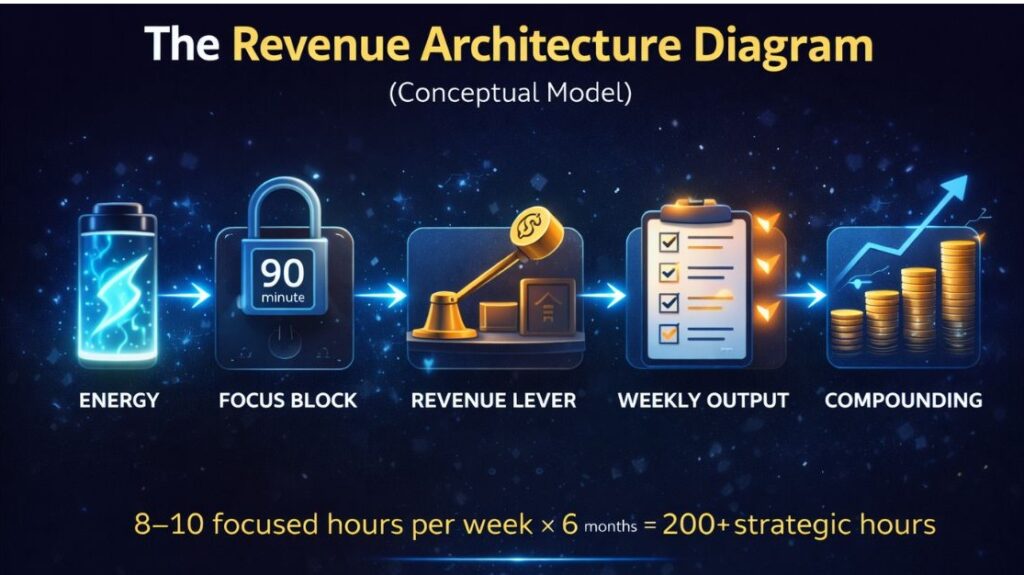
If any step is misaligned, growth stalls.
But when protected:
8–10 focused hours per week × 6 months
= 200+ strategic hours
That’s equivalent to 5 full-time workweeks of revenue-focused output.
Consistency compounds quietly.
What Happens in 6 Months?
If applied correctly:
- 24–30 monetized pieces of content
- 150–200 client conversations
- 1 validated paid offer
- Clear income data
Not theory.
Real traction.
Strategic Questions Smart Side Hustlers Ask Before Building Income
❓Can I realistically build a side hustle working full-time?
Yes — if you protect one focused revenue cycle daily and eliminate low-leverage tasks.
❓How many hours per week are enough?
8–10 hours of structured revenue-focused work is sufficient for measurable progress.
❓Why do most side hustlers fail?
Because they confuse activity with revenue generation and underestimate cognitive fatigue.
❓Is 90 minutes enough?
One high-quality 90-minute block produces more output than 3 distracted hours.
Final Thought
Side hustles don’t grow from intensity.
They grow from structural alignment.
You don’t need:
- 4AM wake-ups
- More productivity apps
- More courses
You need:
- One protected revenue block
- Three weekly levers
- Energy alignment
- Ruthless elimination
Six months from now, your results won’t reflect how motivated you were.
They’ll reflect how structured you were.