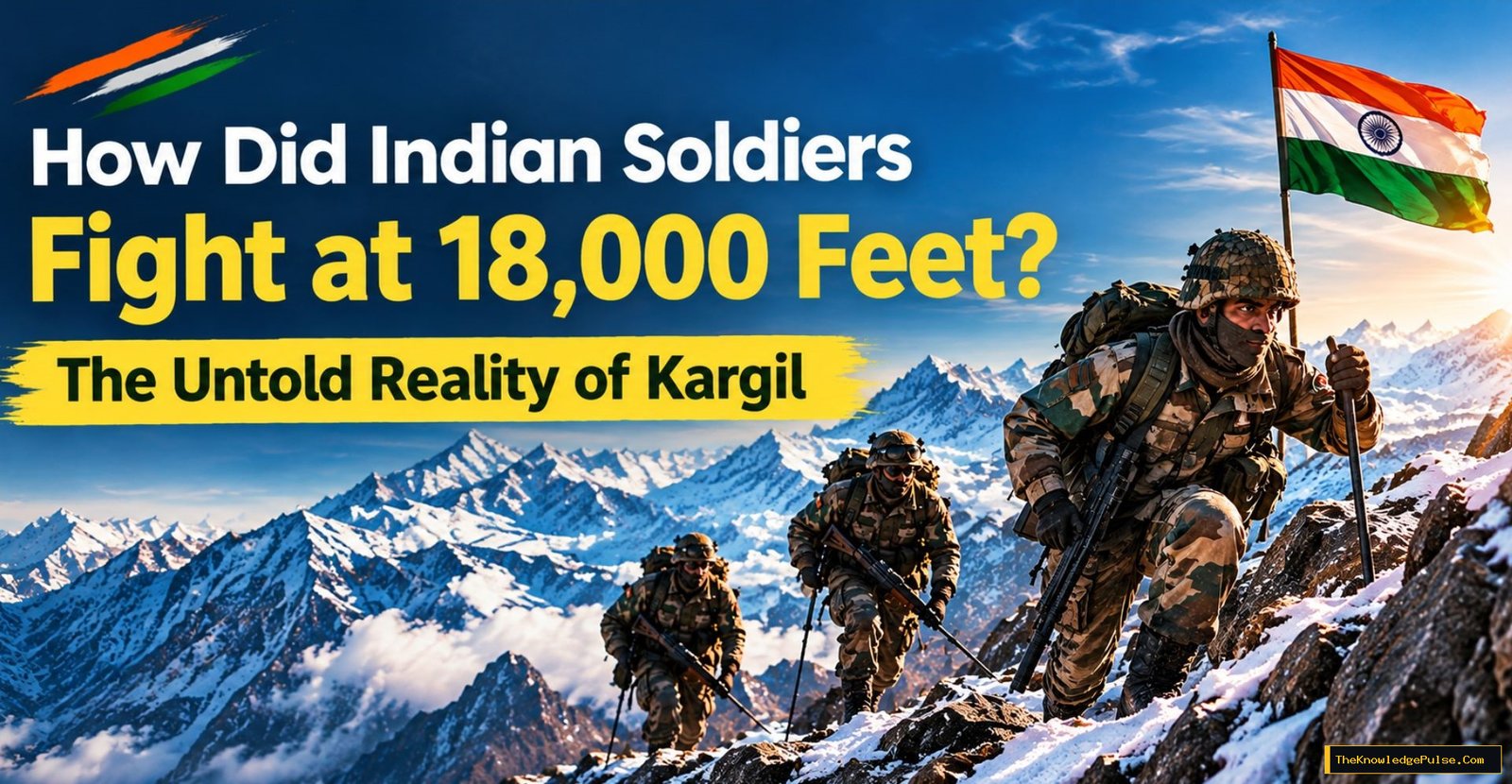
How Did Indian Soldiers Fight at 18,000 Feet? The Untold Reality of Kargil
Imagine climbing a mountain in freezing darkness while carrying a rifle, ammunition and combat equipment — knowing that the enemy is waiting somewhere above you.
Now imagine doing it while breathing air that contains far less oxygen than at sea level.
Your legs are exhausted.
Your hands are numb.
The slope is steep enough to make every step dangerous.
And the men above you have already occupied the high ground.
This was the extraordinary reality of Kargil mountain warfare in 1999.
The phrase Kargil war at 18000 feet has become a powerful way of describing the extreme altitude of the conflict. However, the entire war was not fought at precisely 18,000 feet. Scholarly accounts describe the principal fighting as taking place at roughly 12,000 to 17,000 feet, while some individual positions and accounts place the battlefield at approximately 18,000 feet or higher.
That is what makes Kargil different from the way most people imagine a conventional war.
There were no broad plains for tanks to dominate.
There were no easy roads leading directly to the objective.
There was no comfortable battlefield.
There were mountains.
And the mountains controlled almost everything.
What You’ll Discover
- What Does 18,000 Feet Actually Feel Like?
- Why Oxygen Became a Battlefield Problem
- When the Mountain Became the Enemy
- Why Fighting Uphill Was So Dangerous
- How Soldiers Climbed the Steepest Slopes
- Why Darkness Could Become an Advantage
- How Weapons, Food and Ammunition Reached the Heights
- How Artillery Helped Break Mountain Defences
- How the Indian Air Force Operated at Extreme Altitude
- How Soldiers Fought the Cold and Exhaustion
- How Wounded Soldiers Were Evacuated
- The Soldiers Who Climbed Into the Fire
- Why Kargil Was Unlike Conventional Warfare
- What Kargil Taught India About Mountain Warfare
- Frequently Asked Questions
What Does 18,000 Feet Actually Feel Like?
To understand how soldiers fought in Kargil, it helps to understand what extreme altitude does to the human body.
At sea level, walking several kilometres with a backpack is tiring but manageable for a trained soldier.
At extreme altitude, the same physical effort can become dramatically more demanding.
The air is thinner.
Oxygen availability is lower.
The body must work harder.
And Kargil soldiers were not hiking for recreation.
They were carrying weapons, ammunition, communications equipment and other combat loads.
They were also moving across steep rocky terrain where a normal walking rhythm was often impossible.
Scholarly accounts of the Kargil conflict describe the campaign as fighting among frozen Himalayan peaks at altitudes broadly ranging from approximately 12,000 to 17,000 feet, with some individual positions higher.
At extreme altitude, every step costs more.
During Kargil, soldiers had to keep taking those steps while carrying combat equipment and moving toward enemy fire.
This is the first key to understanding the conflict.
The mountain was not simply where the battle happened.
The mountain shaped how the battle could be fought.
Why Did Oxygen Become a Battlefield Problem?
One of the biggest differences between Kargil and a conventional battlefield was the atmosphere itself.
At high altitude, reduced oxygen availability affects physical performance. A soldier who is perfectly capable at lower elevation can find sustained exertion much more difficult after climbing thousands of feet.
This is why acclimatization is so important in high-altitude military operations.
But acclimatization does not eliminate the problem.
It helps the body adapt.
It does not turn an 18,000-foot mountain into a normal battlefield.
The challenge became even greater because combat required bursts of intense physical effort.
Imagine climbing a steep slope slowly for hours and then suddenly having to sprint, crawl, take cover, fire a weapon or carry another soldier.
That is very different from simply marching through a valley.
The altitude also influenced artillery, aircraft and helicopters. Kargil was therefore not merely an infantry challenge. The environment affected almost every branch of military operations.
When the Mountain Became the Enemy
Military planners usually think about an enemy in terms of soldiers, weapons, positions and strategy.
Kargil added another factor:
terrain.
Steep slopes slowed movement.
Ridges restricted routes.
Cliffs created natural barriers.
Snow and ice made footing difficult.
Valleys could expose troops to observation from above.
And high peaks could become observation posts from which the surrounding battlefield could be watched.
Analyses of the Kargil fighting have emphasized the major tactical advantage enjoyed by forces occupying the heights. A well-positioned defensive force could exploit commanding terrain while attackers had to climb toward it.
That explains one of the most important features of the war.
India had to attack positions that Pakistani forces had already occupied.
The defenders had time to establish positions.
The attackers had to reach them.
Why Was Fighting Uphill So Dangerous?
Imagine two groups of soldiers.
One group is behind rocks and prepared defensive positions on a ridge.
The other is below them.
The second group must climb toward the first.
That difference can be decisive.
The defenders have the advantage of elevation.
They can observe approaches.
They can prepare firing positions.
They can use the terrain for cover.
The attackers, meanwhile, may have to expose themselves as they climb.
This is why the phrase “fighting uphill” is more than a metaphor when describing Kargil.
It was literally true.
Indian infantry, supported by artillery, had to physically evict entrenched forces feature by feature in high-altitude terrain where many of the heights were above 15,000 feet.
The Line of Control also constrained India’s freedom of manoeuvre.
Because India deliberately avoided crossing the LoC during the conflict, it could not simply solve every tactical problem by widening the battlefield.
Many positions therefore had to be attacked directly from the Indian side.
How Did Soldiers Climb the Steepest Slopes?
This is perhaps the most visually extraordinary part of the Kargil story.
Indian troops had to negotiate terrain that could barely be described as a conventional route.
Some approaches involved steep rock faces.
Others involved snow and ice.
Some required ropes and specialized climbing techniques.
The assault force could not simply march in formation.
Small groups often had to move carefully, sometimes at night, using difficult approaches that reduced their exposure to enemy observation.
The objective was not always to find the easiest route.
Sometimes the most important route was the one the enemy least expected.
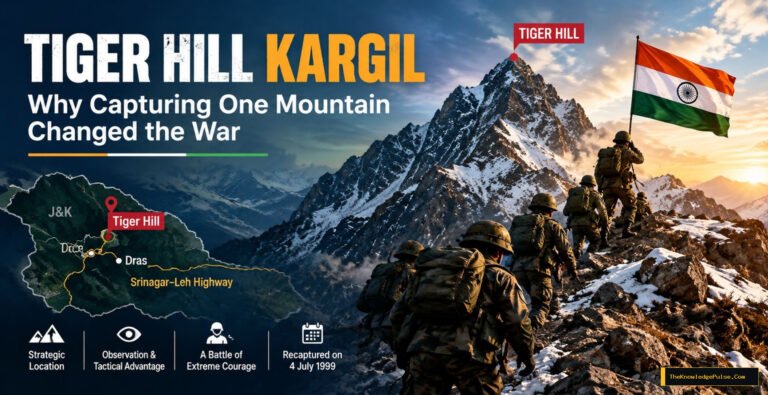
This became famous during the battle for Tiger Hill.
The summit of Tiger Hill was approximately 16,700 feet, and accounts of the assault describe troops using steep approaches and climbing equipment to reach the objective.
The story of Grenadier Yogendra Singh Yadav is particularly associated with this kind of assault.
His actions during the Tiger Hill operation became one of the best-known examples of individual courage during the Kargil War.
But his story also illustrates something larger.
Mountain warfare often depends on the ability of a small number of soldiers to establish the first foothold.
Once that foothold exists, other troops can follow.
Without it, the assault can stall.
Why Could Darkness Become an Advantage?
At first, attacking a mountain at night sounds even more dangerous.
And it was.
But darkness could also provide something invaluable:
concealment.
During daylight, soldiers moving across an exposed mountain slope could be easier to detect.
At night, the darkness could reduce visibility and make an unexpected approach possible.
That did not eliminate the dangers.
It created new ones.
Soldiers had to navigate unfamiliar slopes with limited visibility.
A mistake could send someone sliding down a rocky slope.
A loose stone could reveal movement.
Communication became more difficult.
And once the assault began, darkness could turn the battlefield into a confusing mixture of shadows, muzzle flashes, rocks and explosions.
Yet surprise was enormously valuable.
If soldiers could reach an unexpected approach and establish a foothold, they could potentially attack the defensive system from a direction the enemy considered less likely.
How Did Weapons, Food and Ammunition Reach the Heights?
This is the part of Kargil that is often forgotten.
Everyone remembers the soldier pulling the trigger.
Far fewer people think about the ammunition that had to reach him.
A modern fighting force requires an enormous logistical network.
- Rifles and ammunition
- Machine guns
- Mortars
- Artillery ammunition
- Food
- Water
- Medical supplies
- Warm clothing
- Communication equipment
- Climbing equipment
- Fuel and other supplies
Moving these items through steep mountain terrain was a major challenge.
Vehicles could not simply drive to every fighting position.
Road access was limited.
Some positions could only be reached by foot or through difficult mountain routes.
In other words, Kargil was also a logistics war.
How Did Artillery Help Break Mountain Defences?
If infantry had to physically climb the mountains, artillery provided something infantry could not:
long-range destructive power.
The Bofors FH-77B 155 mm howitzer became one of the most famous weapons associated with the Kargil War.
Indian artillery was used extensively against Pakistani positions.
But mountain artillery presented unusual problems.
Targets could be positioned on steep slopes.
Enemy bunkers could be difficult to see.
Terrain affected observation.
And firing from valleys toward high mountain positions required careful planning.
Yet artillery became crucial in weakening defensive positions before infantry assaults.
Accounts of the conflict describe Indian forces using 155 mm Bofors howitzers extensively and, where terrain and circumstances permitted, employing unusual firing techniques against mountain positions.
Scholarly analyses also describe how Indian forces combined artillery bombardment with determined infantry assaults to progressively evict entrenched forces from the heights.
How Did the Indian Air Force Operate at Extreme Altitude?
The mountains challenged aircraft just as severely as they challenged soldiers.
Aircraft had to operate in an environment of high ridgelines, rapidly changing terrain and targets that could be hidden among rocks.
Unlike a normal battlefield, the targets were often small.
A bunker on a mountainside is a very different target from a large military formation on open ground.
Aircrews also had to be extremely careful because the Line of Control remained a major constraint.
The Indian Air Force therefore had to adapt its tactics during the conflict.
Research into the air campaign explains that aircraft operating at Kargil faced major difficulties because targets were small bunkers located at high altitude, while aircraft themselves were operating in demanding conditions.
Laser-guided weapons were eventually employed to improve bombing accuracy against difficult mountain targets.
The air campaign, known as Operation Safed Sagar, therefore became an important part of the wider campaign.
But air power alone could not capture a mountain.
Someone still had to climb it.
How Did Soldiers Fight the Cold and Exhaustion?
Cold was not simply an inconvenience.
At extreme altitude, exposure could become a serious operational problem.
Soldiers needed appropriate clothing, shelter and protection from the elements.
But combat does not stop because the weather is uncomfortable.
A soldier cannot simply say, “I am exhausted; I will continue tomorrow.”
If an assault is underway, the assault continues.
If ammunition is needed, ammunition must arrive.
If a position must be held, it must be held.
The combination of cold, low oxygen and physical exertion therefore created a unique form of battlefield exhaustion.
How Were Wounded Soldiers Evacuated?
One of the most difficult problems in mountain warfare is what happens after someone is wounded.
At sea level, an ambulance can often reach a casualty quickly.
On a mountain, there may be no road.
There may not even be a safe walking route.
A wounded soldier may have to be carried down a slope while the fighting is still taking place.
That creates a second battlefield:
the battle to save the wounded.
Helicopters became an important part of Kargil’s evacuation and transport effort.
But helicopter operations in mountains have their own complications.
High altitude affects aircraft performance.
Landing zones can be extremely limited.
Mountain winds can be unpredictable.
And aircraft can themselves be exposed to enemy fire.
This meant evacuation was never simply a matter of calling an ambulance.
It could require coordination between frontline troops, medics, ground transport and aviation assets.
The Soldiers Who Climbed Into the Fire
The Kargil War produced many famous heroes.
Captain Vikram Batra.
Grenadier Yogendra Singh Yadav.
Rifleman Sanjay Kumar.
Captain Anuj Nayyar.
And many others.
But focusing only on famous names can obscure the larger reality.
A mountain assault requires an entire chain of people.
Someone must carry ammunition.
Someone must establish communications.
Someone must direct artillery.
Someone must provide medical treatment.
Someone must evacuate the wounded.
Someone must maintain supply routes.
And someone must climb first.
Yogendra Singh Yadav’s role in the Tiger Hill assault is remembered precisely because he became one of those men who climbed toward a heavily defended position despite extraordinary danger.
The important point is not simply that he was brave.
It is that the operation required individual courage to be transformed into tactical progress.
A soldier’s courage had to create a foothold.
The foothold had to allow other soldiers to advance.
The advance had to capture the position.
And the position then had to be held.
Why Was Kargil Unlike Conventional Warfare?
Kargil was a conventional conflict fought under highly unconventional geographic conditions.
| Typical Battlefield | Kargil Battlefield |
|---|---|
| Movement can often be supported by roads and vehicles | Steep terrain severely restricted mobility |
| Attackers may manoeuvre around defensive positions | The LoC restricted India’s ability to manoeuvre across the boundary |
| Troops generally operate at normal oxygen levels | High altitude increased physical strain |
| Defenders and attackers may occupy comparable elevations | Attackers frequently had to assault higher positions |
| Casualties can often be moved rapidly by road | Mountain evacuation could be extremely difficult |
| Artillery targets can often be easier to identify | Small bunkers could be hidden among mountains and ridges |
| Aircraft operate over relatively predictable terrain | Extreme mountain gradients created additional aviation challenges |
It was therefore a war where geography shaped strategy at every level.
Why Could the Higher Ground Be So Powerful?
High ground provides several military advantages.
First, it can provide observation.
From a high ridge, soldiers can potentially see movement across valleys and roads below.
Second, it can improve defensive fire.
Third, it can make an enemy approach more predictable.
Fourth, it can provide natural protection.
Fifth, it can complicate the attacker’s logistics.
That is why the Kargil positions mattered far beyond the physical size of the individual peaks.
A small mountain feature could influence movement across a much larger area.
Why Couldn’t India Simply Bomb Every Position?
This sounds obvious until the geography is considered.
A bunker on a mountain is a tiny target.
The surrounding terrain may be steep.
The target may be concealed.
Friendly troops may be moving nearby.
The aircraft may be operating at extreme altitude.
And the political decision not to cross the Line of Control imposed another restriction on how air power could be employed.
These factors made precision extremely important.
Laser-guided weapons were used to improve accuracy against difficult mountain targets, but even accurate air strikes could not substitute completely for ground forces.
But even the most accurate bomb cannot occupy a mountain.
That still required infantry.
Why Infantry Remained the Decisive Element
This is perhaps the single most important lesson of Kargil.
Artillery could destroy.
Aircraft could strike.
Intelligence could identify.
Logistics could supply.
But infantry had to climb.
And after climbing, infantry had to clear the position.
Then they had to hold it.
The scholarly literature on Kargil repeatedly emphasizes this combination of artillery support and infantry assaults.
India’s forces did not simply bomb the mountains until they were empty.
They fought for the ground.
Feature by feature.
Ridge by ridge.
Peak by peak.
That is why the battle is remembered as one of the most demanding examples of modern high-altitude warfare.
What Did Kargil Teach India About Mountain Warfare?
The conflict exposed weaknesses as well as strengths.
It demonstrated the importance of intelligence and surveillance.
It highlighted the need for specialized high-altitude equipment.
It showed the value of artillery coordination.
It reinforced the importance of air-ground cooperation.
And it demonstrated the continuing importance of logistics in mountainous terrain.
Post-Kargil analysis also examined the intelligence failures surrounding the initial surprise and contributed to wider discussions about India’s defence and security system.
In other words, Kargil was not simply a military victory.
It was also a massive learning experience.
A Battle Where Every Metre Had a Price
It is easy to look at a map of Kargil and see mountains as lines and colours.
But maps hide the physical reality.
A line on a map might represent a cliff.
A marked peak might require hours of climbing.
A short distance might take enormous effort.
A position only a few hundred metres away might be unreachable without ropes.
And an objective that looks tiny on a map could require an entire military operation.
At Kargil, distance was not measured only in kilometres.
It was measured in altitude, vertical metres, exhaustion and lives.
So, How Did Indian Soldiers Fight at 18,000 Feet?
The answer is not one weapon.
It was not one tactic.
It was not one heroic soldier.
It was a combination of preparation, acclimatization, mountain skills, artillery, air support, logistics, intelligence and — ultimately — infantry courage.
Indian soldiers climbed steep approaches.
They moved at night.
They carried weapons and ammunition through difficult terrain.
They endured cold and exhaustion.
They attacked fortified positions from below.
They relied on artillery to weaken enemy defences.
They used air power where the difficult terrain permitted it.
They evacuated casualties from places where roads often could not reach.
And they kept moving upward.
The Most Extraordinary Part of Kargil
Perhaps the most remarkable thing about the Kargil War is that altitude affected almost every part of the conflict.
It affected the soldier.
It affected the weapon.
It affected the aircraft.
It affected the helicopter.
It affected logistics.
It affected casualty evacuation.
It affected artillery.
And it affected strategy.
That is why Kargil occupies such a distinctive place in military history.
This was not simply a war fought in the mountains.
It was a war in which the mountains determined how the war could be fought.
The real story of Kargil: Indian soldiers had to fight an enemy that occupied the heights while simultaneously battling thin air, freezing temperatures, steep cliffs, darkness, exhaustion and an unforgiving landscape.
They did not simply capture mountains.
They fought for every metre of them.
How High Was the Kargil Battlefield?
There is no single altitude that accurately describes the entire conflict.
Different objectives were located at different elevations.
Scholarly accounts describe the main fighting as occurring between approximately 12,000 and 17,000 feet.
Other accounts identify individual positions at higher elevations. For example, Tiger Hill’s summit is commonly described as approximately 16,700 feet, while some positions in the wider Kargil sector were reported at elevations approaching or exceeding 18,000 feet.
Therefore, the phrase Kargil war at 18000 feet is an effective way to communicate the extraordinary altitude involved, but it should not be understood to mean that every engagement took place at exactly 18,000 feet.
Why Kargil Mountain Warfare Was So Brutal
| Challenge | Effect on Soldiers |
|---|---|
| Extreme altitude | Reduced oxygen availability increased the physical difficulty of sustained movement. |
| Steep terrain | Troops often had to climb rather than advance normally. |
| Enemy-held heights | Defenders enjoyed important observation and defensive advantages. |
| Cold | Exposure added another layer of physical stress. |
| Logistics | Ammunition, food and equipment were difficult to move to isolated positions. |
| Night operations | Darkness provided concealment but made navigation and coordination harder. |
| Artillery | Fire support had to be coordinated against targets hidden among difficult terrain. |
| Air operations | High altitude and mountain gradients complicated aircraft operations. |
| Casualty evacuation | Removing wounded soldiers from mountain positions could become a major operation. |
Frequently Asked Questions
Was the Kargil War fought at 18,000 feet?
Some positions involved in the conflict were around or above 18,000 feet, but the entire war was not fought at exactly that altitude. The principal fighting occurred across a range of elevations, with many major positions between approximately 12,000 and 17,000 feet.
Why was high altitude so dangerous?
High altitude reduces oxygen availability and increases the physical demands of movement. When combined with cold, steep slopes, combat loads and enemy fire, the environment became extraordinarily demanding.
Why did Indian soldiers have to attack uphill?
Pakistani forces had occupied dominating heights. Indian forces therefore had to physically recapture those positions. The side holding the heights had a significant tactical advantage.
Did soldiers use ropes during Kargil?
Yes. Some of the steepest approaches required climbing techniques and ropes. The Tiger Hill assault is a prominent example of soldiers using difficult climbing routes to reach the objective.
Why was artillery so important?
Artillery could suppress and damage enemy positions before infantry attempted to capture them. Indian forces used Bofors 155 mm guns extensively during the campaign.
Did the Indian Air Force operate at high altitude?
Yes. Operation Safed Sagar involved demanding air operations in mountainous terrain. High altitude, small targets and steep terrain created significant challenges for aircraft and weapons.
Why were night attacks useful?
Darkness could reduce the defender’s ability to observe approaching troops and therefore create opportunities for surprise. The disadvantage was that soldiers themselves had to navigate extremely difficult terrain with limited visibility.
Was Kargil purely an infantry war?
No. Infantry was essential for physically capturing and holding the mountains, but artillery, air power, logistics, intelligence and medical evacuation were all critical to the campaign.
What made Kargil different from a normal war?
The extraordinary combination of extreme altitude, steep terrain, enemy-held high ground, difficult logistics, cold, limited manoeuvre and political restrictions created a battlefield unlike a conventional low-altitude conflict.
Why is Kargil considered an important example of mountain warfare?
Because Indian forces had to remove entrenched troops from some of the world’s most difficult terrain. The conflict demonstrated how altitude, geography, logistics and fire support can fundamentally shape a modern military campaign.
Read More About the Kargil War
To understand the conflict as a whole, read:
Kargil War 1999: Causes, Battles, Heroes & Impact Explained
To understand the strategic thinking behind the infiltration, read:
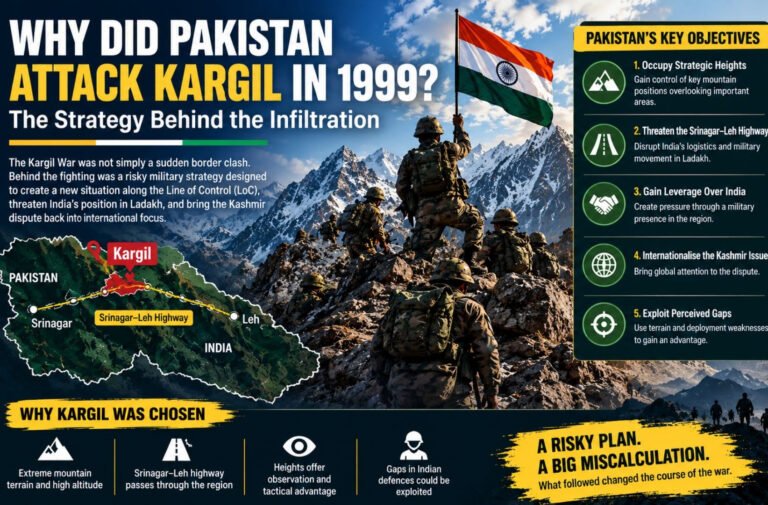
Why Did Pakistan Attack Kargil in 1999? The Strategy Behind the Infiltration
And for the famous battle for one of Kargil’s most important peaks:
Tiger Hill Kargil: Why Was Capturing One Mountain So Important?
Trusted External References
- Cambridge University Press — Asymmetric Warfare in South Asia: The Causes and Consequences of the Kargil Conflict
- MP-IDSA — Analysis of high-altitude military operations and the Kargil experience
- U.S. Army / Military Review — Coercive Strategies and the 1999 Kargil Crisis
- The National Interest — Showdown at Kargil: South Asia Could Have Seen Nuclear War in 1999
- MP-IDSA / Journal of Defence Studies — Kargil and its Impact on India’s National Security
Conclusion: At Kargil, the Mountain Was Part of the War
The question “How did Indian soldiers fight at 18,000 feet?” sounds like a question about altitude.
It is actually a question about endurance.
How do you keep climbing when your body is demanding oxygen?
How do you continue when the temperature is freezing?
How do you carry ammunition when every kilogram feels heavier?
How do you attack when the enemy is already above you?
How do you evacuate a wounded soldier when there is no easy road?
And how do you keep moving when the mountain itself seems to be telling you to stop?
That was the reality of Kargil.
Indian troops were fighting a conventional military campaign in an environment that was anything but conventional.
They relied on artillery.
They relied on air power.
They relied on logistics.
They relied on intelligence.
They relied on mountain skills.
But ultimately, every captured peak required soldiers to physically reach it.
At Kargil, victory was not measured only by kilometres.
It was measured in metres of altitude.
And every metre had to be earned.
That is why the story of the Kargil war at 18000 feet remains so powerful.
It was not simply a battle between armies.
It was a battle fought against an enemy occupying the heights — while nature itself became another adversary.
And that is perhaps the most important thing to remember about Kargil:
Indian soldiers did not simply fight on the mountains.
They fought their way up them.