Why Did Pakistan Attack Kargil in 1999? The Strategy Behind the Infiltration
The Kargil War was not simply a sudden border clash. Behind the fighting was a risky military strategy designed to create a new situation along the Line of Control (LoC), threaten India’s position in Ladakh, and bring the Kashmir dispute back into international focus.
But what exactly was Pakistan trying to achieve?
Why were the mountains around Kargil selected?
Why was the Srinagar–Leh highway so important?
And why did Pakistan’s leadership believe that occupying high-altitude positions could produce a major strategic advantage without triggering a much larger war?
The answers explain why the Kargil infiltration initially surprised India, why the operation appeared strategically attractive to its planners, and why the plan eventually collapsed under military and diplomatic pressure.
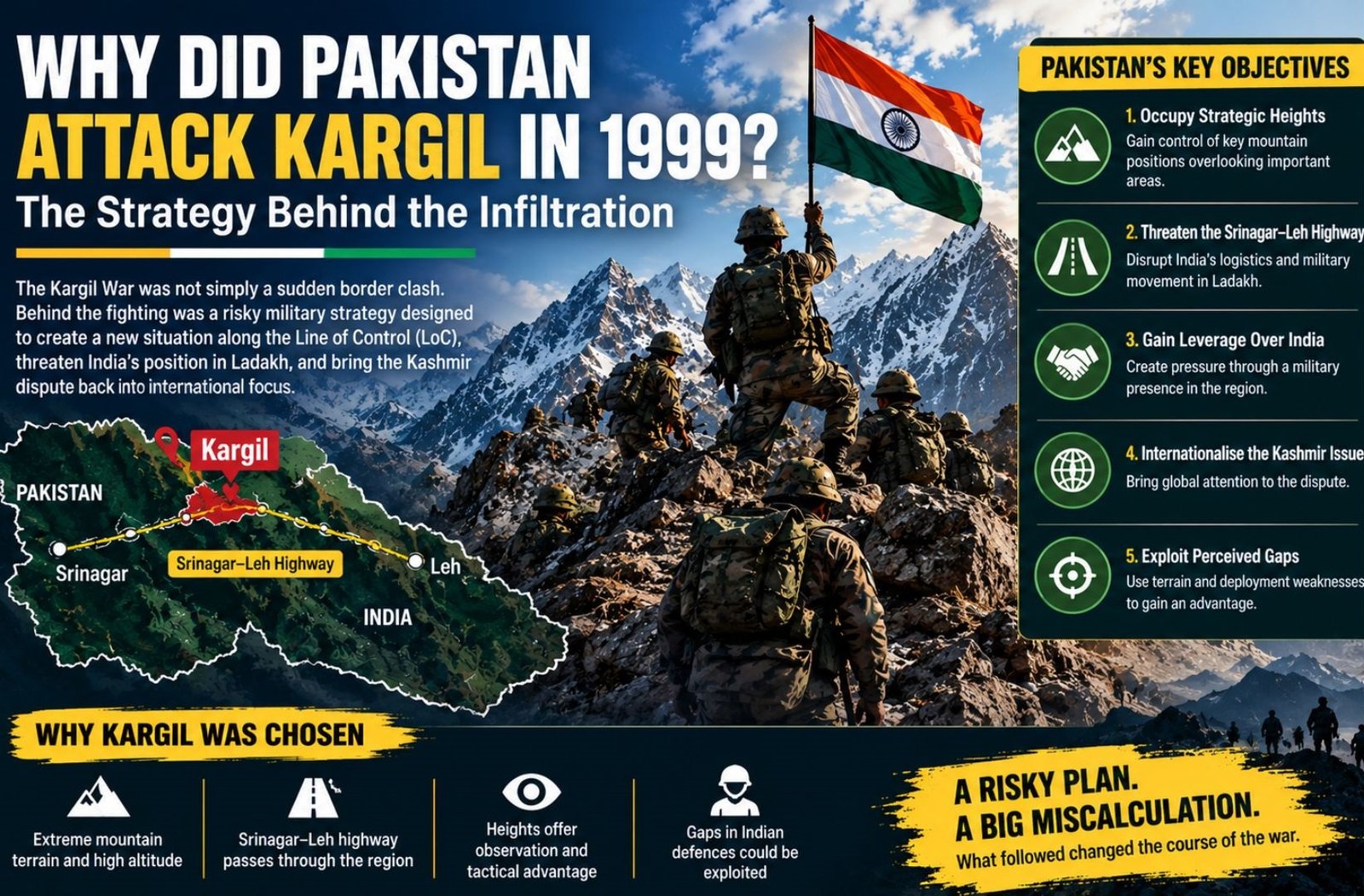
Pakistan’s Kargil strategy appears to have combined several objectives: occupying strategically important heights, threatening the Srinagar–Leh road, gaining leverage over India, attempting to internationalise the Kashmir issue, and exploiting what Pakistani planners believed were weaknesses or gaps in India’s deployment.
Table of Contents
- Why Kargil Was Chosen
- What Was Pakistan Trying to Achieve?
- Why the Srinagar–Leh Road Mattered
- The Element of Surprise
- The Kashmir Strategy
- Why Pakistan Expected India to Hesitate
- The Nuclear Factor
- The Biggest Strategic Miscalculation
- Why the Pakistan Kargil Plan Failed
- What Kargil Revealed
- Frequently Asked Questions
- Trusted References
- Conclusion
Why Was Kargil Chosen?
To understand why the Kargil sector became the focus of the 1999 conflict, it is important to understand its geography.
The Kargil region contains some of the world’s most difficult military terrain. Mountains rise to extreme elevations, movement is difficult, and the major road connecting Srinagar with Leh passes through the wider region.
For an army operating in Ladakh, that road was far more than an ordinary highway. It was a critical logistical route connecting the Kashmir Valley with military positions and supplies farther east.
That made the surrounding heights strategically valuable.
If an opposing force could occupy positions overlooking sections of the road, it could potentially observe and interfere with movement along the route.
According to accounts by Indian military officers who studied the operation, Pakistani forces selected areas where gaps in Indian defences could be exploited and where the terrain offered a significant tactical advantage from elevated positions.
The operation therefore depended heavily on geography.
What Was Pakistan Trying to Achieve?
There was not necessarily one single objective behind the operation. The available military analysis points toward a combination of tactical and strategic goals.
Several objectives are frequently identified when examining the Pakistan Kargil plan.
1. Gain Control of Strategic Heights
The first objective was to occupy mountain positions overlooking important approaches and roads.
High ground is particularly valuable in mountain warfare because observation from elevated positions can provide a major advantage over forces moving below.
Once troops are established on fortified heights, an attacking force has to climb toward them while dealing with difficult terrain, limited oxygen and defensive fire.
This is one reason the initial Pakistani positions were so difficult for Indian troops to recapture.
2. Threaten the Srinagar–Leh Highway
The second major objective was connected to the road linking Srinagar and Leh.
Pakistani positions overlooking parts of the road could potentially disrupt military logistics and create pressure on India’s ability to sustain forces in Ladakh.
Indian military analysis has described the road as a vital logistical artery because supplies for Ladakh had to be stocked and transported through difficult terrain.
Pakistan did not need to capture the entire highway to create a serious problem. Even the ability to observe, shell or threaten important stretches could potentially force India to divert resources and rethink its logistics.
3. Create a New Situation Along the LoC
Another important element was the attempt to alter the existing military situation along the Line of Control.
By occupying heights that were effectively on India’s side of the LoC, the operation attempted to create a new reality on the ground before India could react.
If the positions could be held for long enough, Pakistan might have hoped that India would eventually be forced to negotiate from a weaker position.
This was an extremely risky assumption.
4. Internationalise the Kashmir Issue
Kashmir was at the centre of India-Pakistan tensions long before 1999.
One strategic interpretation of the Kargil operation is that Pakistan wanted to bring the Kashmir dispute back into international attention.
Lieutenant General Mohinder Puri, who commanded India’s 8 Mountain Division during the conflict, later wrote that at the strategic level Pakistan’s aims included embarrassing India and internationalising the Kashmir issue.
The calculation was that a sudden crisis in Kashmir, particularly one involving two nuclear-armed states, would attract international diplomatic intervention.
That could potentially give Pakistan an opportunity to put Kashmir back at the centre of international diplomacy.
Why Was the Srinagar–Leh Road So Important?
One of the easiest ways to understand the Kargil strategy is to look at the map.
The mountains were not important merely because they were mountains.
They were important because of what they overlooked.
| Strategic Feature | Why It Mattered |
|---|---|
| High mountain positions | Provided observation and defensive advantage |
| Srinagar–Leh road | Important logistical connection to Ladakh |
| Dras sector | Contained positions overlooking important road approaches |
| Batalik sector | Provided additional routes and strategic positions near the LoC |
| Mushkoh Valley | Offered difficult terrain and potential avenues for infiltration |
From a military perspective, occupying a mountain peak is useful only if that position provides an operational advantage.
In Kargil, several of the occupied positions had the ability to observe or threaten important movement routes.
That is why the conflict quickly became much more serious than a conventional border skirmish.
The Element of Surprise Was Central to the Plan
The Kargil infiltration explained in its simplest form was built around surprise.
Indian forces initially did not understand the full scale of the intrusion.
The infiltrators had established themselves in extremely difficult terrain, and the mountains themselves helped conceal their presence.
By the time the scale of the operation became clear, the occupying forces had already established defensive positions on several heights.
This gave the defenders an enormous advantage.
If India discovered the operation late, Pakistan could establish strong defensive positions before a large-scale Indian response became possible.
The timing also mattered.
Winter conditions in the region make many high-altitude positions extremely difficult to occupy and maintain. As the weather improved, movement into the mountains became more practical.
The operation therefore attempted to exploit geography, seasonal conditions and gaps in surveillance simultaneously.
Was Kargil Really About Kashmir?
Yes—but not in the simple sense of trying to capture all of Kashmir through a conventional invasion.
The Kargil operation was closely connected to the larger India-Pakistan confrontation over Kashmir.
Pakistan had long supported an insurgency and infiltration strategy in Jammu and Kashmir. Kargil represented a different approach: instead of relying only on covert infiltration by militants, regular military personnel were involved in occupying strategically important positions.
The strategic hope was that military pressure could strengthen Pakistan’s position on the Kashmir issue.
There was also a broader calculation.
If fighting erupted between India and Pakistan shortly after the Lahore Declaration of February 1999, the international community would likely pay close attention.
That created the possibility that outside powers might intervene diplomatically.
From Pakistan’s perspective, international involvement could potentially transform a local military confrontation into a wider diplomatic discussion about Kashmir.
However, this calculation ultimately worked against Pakistan.
Why Did Pakistan Expect India to Hesitate?
This may have been the most important assumption behind the operation.
Pakistan’s planners appear to have believed that India would face difficult choices after discovering the intrusion.
Indian forces would have to attack extremely difficult mountain positions, while the political leadership would also have to consider the possibility of escalation.
There was another important factor: the nuclear weapons possessed by both countries.
Pakistan may have believed that the risk of escalation would make India cautious.
That assumption was only partly correct.
India did respond cautiously in one important sense: Indian forces were ordered to restrict their military operations to the Indian side of the Line of Control.
But caution did not mean inaction.
Instead, India concentrated large military resources on recapturing the occupied positions.
India’s desire to avoid uncontrolled escalation did not mean India would accept a permanent change in the status quo along the LoC.
Did Nuclear Weapons Change the Kargil Strategy?
The nuclear dimension made the entire operation extraordinarily dangerous.
India and Pakistan had conducted nuclear tests in 1998, only about a year before the Kargil conflict.
This meant that any major military confrontation between the two countries carried a risk of wider escalation.
For Pakistan, the existence of nuclear weapons may have appeared to create a strategic shield.
The calculation could be described as follows:
- Conduct a limited military operation.
- Avoid an obvious full-scale invasion.
- Use difficult terrain as protection.
- Rely on nuclear deterrence to discourage India from expanding the conflict.
- Force international powers to intervene if the crisis escalated.
But deterrence is not the same as immunity.
India demonstrated that a limited conventional military response could still be undertaken without crossing the international boundary or turning the conflict into a much larger war.
The Biggest Strategic Miscalculation
The biggest problem with the Pakistan Kargil plan was not necessarily the initial tactical idea.
Occupying high ground overlooking an important road was militarily logical.
The deeper problem was what would happen after India discovered the operation.
Any successful military plan needs a realistic end state.
In Kargil, questions about the final outcome became increasingly difficult:
- How long could the positions be supplied?
- How would the occupying troops be reinforced?
- What would happen if India launched a large counterattack?
- Could the positions be defended throughout the summer?
- How would Pakistan explain the presence of its troops internationally?
- How could the operation end without creating a much larger war?
These questions became increasingly important as India mobilised.
The terrain that initially helped the attackers eventually became a major burden.
Supplying troops at extreme altitude is difficult even during favourable conditions.
Once Indian forces began systematically attacking the positions, the isolated mountain posts became increasingly difficult to sustain.
Why Did the Pakistan Kargil Plan Fail?
The operation failed because several assumptions did not survive contact with reality.
| Pakistani Assumption | What Happened |
|---|---|
| India might not detect the full intrusion quickly | The scale of the operation was eventually identified and a major response followed. |
| India might hesitate to attack difficult heights | Indian troops launched repeated assaults despite the terrain. |
| Nuclear deterrence would restrict India’s response | India conducted a major conventional operation while limiting the conflict geographically. |
| International pressure could benefit Pakistan | Diplomatic pressure increasingly focused on withdrawal and restoration of the LoC status quo. |
| Occupied positions could provide lasting leverage | Indian forces gradually recaptured the positions. |
The strategic picture therefore changed rapidly.
What had initially been a surprise operation became a difficult defensive battle for Pakistan.
India’s decision not to cross the LoC also helped its diplomatic position.
Rather than expanding the war into Pakistani territory, India concentrated on restoring the previous military situation.
What Did Kargil Reveal About Military Strategy?
The Kargil conflict demonstrated that geography can produce enormous tactical advantages—but only if those advantages can be converted into a sustainable strategic outcome.
It also demonstrated the importance of surveillance and intelligence in mountainous regions.
The Kargil Review Committee, established after the conflict, examined the events leading to the Pakistani intrusion and identified significant weaknesses in India’s intelligence gathering, coordination and border management.
The conflict therefore became much more than a battlefield victory or defeat.
It became a major case study in how a surprise operation can exploit gaps between intelligence, military planning and political decision-making.
Kargil showed that winning the opening move of a conflict does not guarantee strategic success. Surprise can create an advantage, but logistics, diplomacy, political objectives and the ability to sustain military positions ultimately determine whether that advantage lasts.
Why Kargil Remains Strategically Important
More than two decades later, Kargil remains important because it changed how India viewed high-altitude security and military preparedness.
The conflict demonstrated that even during periods of diplomatic engagement, military vigilance cannot be relaxed.
It also highlighted the importance of understanding the difference between tactical success and strategic success.
Pakistan initially achieved tactical surprise.
It occupied difficult high-altitude positions and created a serious military challenge.
But the operation did not achieve its larger strategic objectives.
India recovered the occupied positions, the LoC remained the central reference point, and the international diplomatic environment did not develop in Pakistan’s favour.
Frequently Asked Questions
Why did Pakistan attack Kargil in 1999?
Pakistan’s military operation appears to have pursued several objectives, including occupying strategic heights, threatening the Srinagar–Leh road, gaining leverage along the LoC, and attempting to bring the Kashmir issue back into international focus.
What was Pakistan’s plan in Kargil?
The plan involved establishing troops in strategically important high-altitude positions before India could fully detect and respond to the intrusion. From these positions, Pakistani forces could observe and potentially threaten important routes through the Kargil region.
Why was Kargil strategically important?
Kargil was important because several mountain positions overlooked important approaches and portions of the Srinagar–Leh road, which was a vital logistical connection to Ladakh.
Did Pakistan expect India to start a larger war?
The available analysis suggests that Pakistani planners believed India’s response would be constrained by the difficult terrain, escalation risks and the nuclear environment. India instead mounted a major operation while keeping its forces on its side of the Line of Control.
Was the Kargil War part of the Kashmir conflict?
Yes. Kargil was directly connected to the wider India-Pakistan dispute over Kashmir. The military operation was intended to create pressure and alter the situation along the Line of Control.
Why did Pakistan lose the Kargil War?
The operation ultimately failed because India mobilised sufficient military force to recapture the occupied positions, Pakistani forces faced difficult logistical conditions, and the expected diplomatic and strategic advantages did not materialise.
What was the biggest mistake in the Kargil strategy?
The major strategic weakness was the assumption that an initial surprise and occupation of high ground could be converted into lasting political leverage without producing a response strong enough to remove the intruders.
Trusted References
For readers who want to study the Kargil strategy beyond a general summary, these sources provide different perspectives on the conflict, its strategic objectives, intelligence failures, diplomacy and the wider India–Pakistan security environment:
- MP-IDSA — National Security Decision Making: Overhaul Needed — examines the Kargil Review Committee, intelligence coordination problems and the national-security reforms that followed the 1999 conflict.
- Council on Foreign Relations — Why India and Pakistan Are Fighting Over Kashmir Again — provides broader context on the Kashmir dispute and explains how the 1999 Kargil conflict emerged within the longer India–Pakistan confrontation.
- United States Institute of Peace — Kashmir: A Simulation on Peacekeeping in Kashmir — discusses the 1999 Kargil crisis, the strategic Srinagar–Kargil road, the fighting around the occupied heights and the subsequent diplomatic pressure on Pakistan.
- Standing Committee on Defence / MP-IDSA — Report on Implementation of National Security Reforms — records the background of the Kargil Review Committee and highlights problems involving intelligence sharing, coordination between the armed forces and civil authorities, and national-security management.
- Council on Foreign Relations — Southern Asia’s Nuclear Powers — provides useful background on the nuclear environment surrounding India and Pakistan and explains why the 1999 conflict carried wider escalation risks.
- Council on Foreign Relations — U.S.–India Relations — includes a concise chronology of the 1999 Kargil conflict and the diplomatic intervention that contributed to Pakistan’s withdrawal.
- Council on Foreign Relations — India–Pakistan Conflict and Kargil — useful for understanding the broader strategic and diplomatic context surrounding the India–Pakistan confrontation.
Source note: The sources above represent different types of material, including strategic analysis, institutional research, historical records and international-policy assessments. They should be read together rather than treated as a single definitive account of Pakistan’s internal decision-making.
Editorial note: Accounts of the exact intentions and internal planning of Pakistan’s political and military leadership differ in some historical details. This article therefore distinguishes between documented events and strategic interpretations, and avoids presenting every disputed claim as an established fact.
Conclusion: What Was Pakistan Really Trying to Achieve?
The answer to “why did Pakistan attack Kargil?” is more complicated than simply saying it wanted to capture mountains.
The mountains were the means—not necessarily the ultimate objective.
By occupying strategically positioned heights, Pakistan could threaten important routes, create military pressure on India, attempt to alter the situation along the Line of Control, and potentially force international powers to pay greater attention to Kashmir.
The strategy depended heavily on surprise.
It also depended on another assumption: that India would be unable or unwilling to respond strongly without crossing into a much wider conflict.
That assumption proved wrong.
India chose to fight for the occupied positions while maintaining a limited geographical scope to the conflict. Indian troops eventually recaptured the key heights, while international diplomatic pressure increasingly favoured withdrawal and restoration of the previous status quo.
Pakistan’s opening move demonstrated the power of surprise, geography and high ground. But Kargil also demonstrated that tactical surprise cannot guarantee strategic victory. A military plan ultimately has to survive not only the first response from the enemy, but also logistics, diplomacy, escalation risks and the political objectives of the conflict.
Related reading: If you want to understand the battlefield itself, read our detailed guide to the Kargil War 1999: Causes, Battles, Heroes & Impact.
Editorial note: This article is intended for historical and educational purposes. It discusses military strategy and historical events without endorsing the actions of either side.