Tiger Hill Kargil: Why Capturing One Mountain Changed the War
Tiger Hill Kargil has become one of the most recognizable names of the 1999 Kargil War. But the importance of Tiger Hill was not simply that it was a high mountain captured by Indian soldiers.
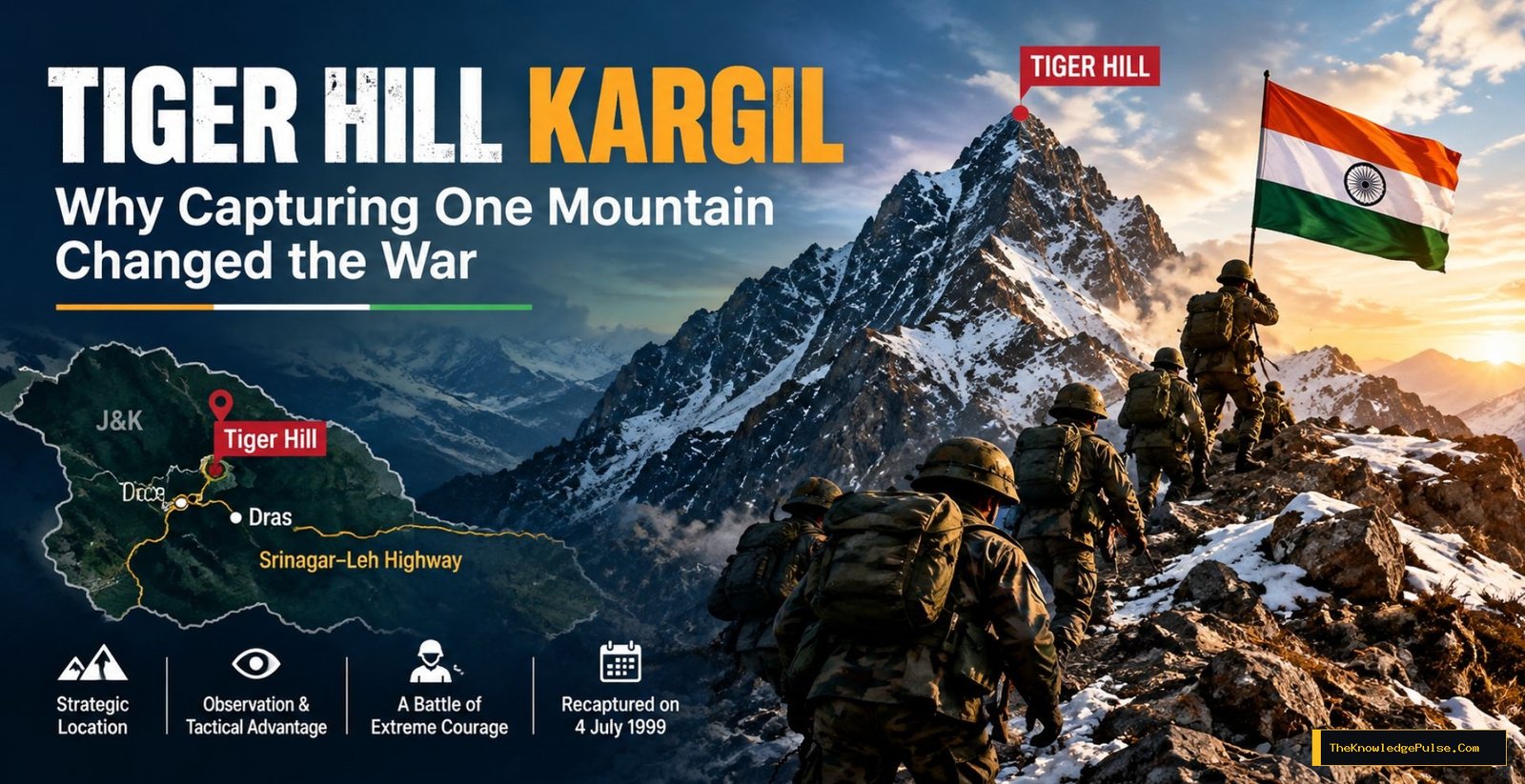
The peak was part of a larger network of dominating heights in the Dras sector. From these heights, Pakistani forces could observe and influence movement along the important Srinagar–Leh route. Recapturing Tiger Hill therefore had significance far beyond the summit itself.
The battle also demonstrated one of the defining characteristics of Kargil: Indian troops had to attack positions held by an enemy that occupied the higher ground. Soldiers climbed steep, exposed and often near-vertical approaches while facing machine-gun fire, artillery, extreme cold and thin air.
Tiger Hill was important because its commanding position in the Dras sector gave the occupying forces a major observation and tactical advantage over the surrounding battlefield and the Srinagar–Leh highway. Its recapture on 4 July 1999 became one of the defining successes of Operation Vijay and helped shift momentum decisively toward India.
What You’ll Learn
- Where Is Tiger Hill?
- Why Was Tiger Hill Important?
- Why Was the Tiger Hill Battle So Difficult?
- How Did Indian Soldiers Approach Tiger Hill?
- Tiger Hill Battle Timeline
- The Role of Artillery and Air Power
- Grenadier Yogendra Singh Yadav and the Assault
- How Tiger Hill Was Finally Captured
- What Happened After Tiger Hill Was Captured?
- Why Tiger Hill Changed the War
- Frequently Asked Questions
Where Is Tiger Hill?
Tiger Hill is located in the Dras sector of the Kargil region, an area characterized by steep mountains, narrow valleys and extremely high elevations.
The Dras sector was strategically important because several dominating heights overlooked important ground and routes in the area. During the Kargil conflict, Pakistani forces occupied a number of such positions after crossing the Line of Control.
Tiger Hill became one of the most important objectives for the Indian Army because of its commanding position within this network of heights.
The battlefield itself created enormous difficulties. Indian soldiers were not approaching an ordinary hill from a convenient road. They were attempting to climb steep rocky faces while the defenders had the advantage of elevation and prepared positions.
That difference explains much of the extraordinary difficulty of the Tiger Hill battle.
Why Was Tiger Hill Important?
The simplest answer to why Tiger Hill was important is its commanding location.
High ground has always mattered in mountain warfare. A force occupying a dominant peak can observe movement below, establish defensive positions and use the surrounding terrain to its advantage.
In Kargil, this advantage was particularly significant because the surrounding roads and valleys were essential for moving troops and supplies.
Indian government material describes the occupied Kargil heights as dominating the Srinagar–Leh highway, while contemporary reporting has specifically described Tiger Hill as overlooking the strategic route.
This is why Tiger Hill became a priority objective during Operation Vijay.
Why Was the Tiger Hill Battle So Difficult?
Imagine trying to climb a mountain at night while carrying weapons and ammunition, with the enemy positioned above you.
Now remove much of the available cover and add freezing temperatures, difficult rock faces and low oxygen.
That was the basic problem facing Indian infantry during the assault.
At high altitude, physical exertion becomes much more demanding. Every climb consumes enormous energy, while carrying combat equipment makes movement even harder.
The defenders also had an important advantage: they were already positioned on the heights.
Indian soldiers therefore had to fight their way upward instead of defending an established position.
Official accounts of the Kargil operations repeatedly emphasize the combination of steep terrain, extreme altitude, enemy fire and difficult weather conditions. Some battlefield locations were above 5,000 metres.
How Did Indian Soldiers Approach Tiger Hill?
The assault required more than simply sending a large number of troops directly toward the summit.
The terrain made conventional movement extremely difficult. Indian units studied the approaches, used supporting fire and attempted to reach positions from directions that could reduce the advantage enjoyed by the defenders.
One of the most famous elements of the assault involved soldiers climbing a steep cliff face that appeared extremely difficult to scale.
According to government accounts, Grenadier Yogendra Singh Yadav volunteered to lead a climbing team toward the Tiger Hill position. He climbed a steep, snow-covered rocky approach at an altitude of nearly 16,500 feet despite intense enemy fire.
His role became one of the defining stories of the battle.
The assault demonstrated an important principle of mountain warfare: sometimes the route that appears least likely to be used can become the route that creates tactical surprise.
Tiger Hill Battle Timeline
| Date | What Happened |
|---|---|
| May 1999 | The wider Kargil conflict began to emerge as Indian forces discovered that Pakistani troops and intruders had occupied positions on dominating heights. |
| 13 June 1999 | Indian forces recaptured Tololing, providing an important breakthrough in the Dras sector and opening the way for further operations. |
| 24 June 1999 | Indian Air Force Mirage 2000 aircraft conducted important strikes against positions associated with Tiger Hill, including the first operational use of laser-guided bombs by the IAF. |
| Late June | Indian ground forces continued preparing for the assault while artillery and air operations targeted enemy positions and supporting areas. |
| 3 July 1999 | Elements of the assault force began the difficult climbing operation toward key Tiger Hill positions. Grenadier Yogendra Singh Yadav played a prominent role in the advance. |
| 4 July 1999 | Indian troops recaptured Tiger Hill after a fierce assault. The victory became one of the most important successes of Operation Vijay. |
| 6 July 1999 | Indian forces faced a Pakistani counterattack in the Tiger Hill area, demonstrating that the capture did not immediately end fighting around the feature. |
| July 1999 | Indian forces continued operations against remaining occupied positions until the conflict moved toward its conclusion. |
The Role of Artillery and Air Power
The story of Tiger Hill is often remembered primarily as an infantry assault. But that is only part of the story.
Artillery was critical.
Indian artillery was used to suppress enemy positions and destroy or damage defensive locations before and during infantry operations. The difficult terrain made direct infantry attacks extraordinarily costly, so concentrated firepower became an essential part of the campaign.
Air power also played an important role.
The Indian Air Force used Mirage 2000 aircraft against targets connected with the Tiger Hill position. On 24 June 1999, Mirage 2000 aircraft employed laser-guided bombs against the enemy position, an important milestone in India’s use of precision-guided weapons during the conflict.
According to Indian Air Force historical material, the strikes caused significant damage and contributed to weakening the position before the eventual ground assault.
Grenadier Yogendra Singh Yadav and the Assault
Among the soldiers associated with Tiger Hill, Grenadier Yogendra Singh Yadav became one of the most famous.
He was part of the 18 Grenadiers and was involved in an assault that required soldiers to climb an extremely difficult cliff face.
Government accounts state that Yadav volunteered to lead the climbing team. He was wounded multiple times but continued fighting, helping neutralize enemy positions and enabling other soldiers to continue the climb. He was later awarded the Param Vir Chakra, India’s highest military decoration for gallantry.
The significance of his story goes beyond one individual.
The assault required soldiers to continue moving despite casualties and extreme physical conditions. Once a small group could establish a foothold, additional troops could use the route and expand the attack.
That combination of individual courage and tactical purpose was central to the Tiger Hill operation.
How Tiger Hill Was Finally Captured
The final capture of Tiger Hill came after sustained operations involving multiple elements of India’s military effort.
Indian troops approached the position using difficult routes while artillery and air strikes were used against enemy positions.
The ground assault itself involved close combat around fortified positions.
After the fighting, Indian troops secured the summit and surrounding positions. On 4 July 1999, Tiger Hill was officially back under Indian control. The Indian government later described the capture as one of the defining moments of the Kargil conflict.
The victory was particularly important because it came after the earlier capture of Tololing and other features in the Dras sector.
In other words, Tiger Hill was not an isolated battle. It was part of a progressively larger effort to dismantle the network of occupied heights.
What Happened After Tiger Hill Was Captured?
The capture of Tiger Hill did not immediately end the Kargil War.
Fighting continued in other areas, including around Point 4875, Batalik and the Mushkoh Valley.
There was also a Pakistani counterattack in the Tiger Hill area after the initial capture. Historical accounts describe intense fighting on 6 July, showing that possession of the mountain remained contested even after the main Indian assault.
Nevertheless, the strategic and psychological effect of the victory was substantial.
Indian forces had demonstrated that even heavily defended dominating heights could be recaptured through sustained preparation, firepower and infantry operations.
The campaign then continued against the remaining occupied positions.
Why Tiger Hill Changed the War
So, why was Tiger Hill important enough to become one of the defining symbols of Kargil?
There were several reasons.
1. It Was a Dominating Position
Tiger Hill formed part of the high ground overlooking the surrounding Dras battlefield. Its position gave the occupying force an important tactical advantage.
2. It Was Connected to the Wider Battle for the Dras Sector
The battle for Tiger Hill followed earlier Indian successes such as Tololing. The capture therefore formed part of a larger campaign to recover the dominating heights.
3. It Demonstrated the Difficulty of Mountain Warfare
The operation showed how different high-altitude combat is from conventional warfare on flat terrain. Indian soldiers had to attack uphill against positions that had already been prepared.
4. It Demonstrated the Value of Combined Firepower
Artillery and air strikes played an important role in weakening enemy positions and supporting the infantry assault. The Tiger Hill operation became an example of how different arms could work together under difficult battlefield conditions.
5. It Had a Major Psychological Effect
The recapture of such a prominent peak became a powerful symbol of India’s ability to reverse the initial battlefield situation.
Official Indian accounts describe the capture as a decisive moment that shifted momentum in India’s favour.
Tiger Hill Was More Than a Mountain
It is easy to remember the Tiger Hill Kargil War story as a dramatic climb followed by the raising of the Indian flag.
But the military significance was much greater.
Tiger Hill represented the central problem faced by Indian forces during the Kargil conflict: how do you remove a determined enemy from extremely high and heavily defended terrain without crossing the Line of Control?
The answer required patience, artillery, air support, intelligence, logistics and extraordinary infantry courage.
The battle also showed why controlling high ground matters so much in mountainous warfare. A single dominating feature can influence movement across a much larger area.
That is why Tiger Hill became more than another objective on the Kargil battlefield.
How Tiger Hill Fits Into the Larger Kargil War
If you want to understand the entire conflict, Tiger Hill should be viewed as one chapter in a much larger story.
Our main guide, Kargil War 1999: Causes, Battles, Heroes & Impact Explained, covers the broader causes, timeline, major battles, heroes and long-term consequences of the war.
For the strategic question of why Pakistan launched the Kargil operation in the first place, see Why Did Pakistan Attack Kargil in 1999? The Strategy Behind the Infiltration.
Together, these articles provide three different ways to understand Kargil: the overall conflict, the strategy behind the infiltration, and the battlefield story of Tiger Hill.
Frequently Asked Questions About Tiger Hill Kargil
What is Tiger Hill in the Kargil War?
Tiger Hill was a strategically important high feature in the Dras sector that was occupied by Pakistani forces during the 1999 Kargil conflict. Indian forces recaptured it on 4 July 1999.
Why was Tiger Hill important?
Tiger Hill was important because its commanding position gave the occupying forces a significant tactical advantage over the surrounding terrain and contributed to the wider threat to movement along the Srinagar–Leh route.
When was Tiger Hill captured?
Indian forces recaptured Tiger Hill on 4 July 1999 after a difficult assault.
Who was the Tiger Hill hero?
Grenadier Yogendra Singh Yadav is one of the most famous heroes associated with the Tiger Hill assault. He displayed exceptional courage while climbing the difficult approach under enemy fire and was awarded the Param Vir Chakra.
What role did the Indian Air Force play at Tiger Hill?
The Indian Air Force conducted strikes against enemy positions around Tiger Hill. Mirage 2000 aircraft used laser-guided bombs against the position in June 1999, marking an important development in India’s use of precision-guided weapons during the conflict.
Did capturing Tiger Hill end the Kargil War?
No. Although Tiger Hill was a major victory, fighting continued in other sectors. Indian forces continued operations against remaining occupied positions until the conflict moved toward its conclusion in July 1999.
How high was the Tiger Hill battlefield?
Tiger Hill was among the very high mountain features of the Dras sector. Accounts of the assault describe soldiers operating at roughly 16,500 feet, while the wider Kargil battlefield included positions above 5,000 metres.
Trusted References
For readers who want to study Tiger Hill and the wider Kargil conflict beyond this article, the following sources provide historical, military and strategic context from different institutions and publications:
- Press Information Bureau — Kargil War and Operation Vijay overview — official Government of India material covering the Kargil conflict and Operation Vijay.
- The Indian Express — Israeli help and Indian jugaad in recapture of Tiger Hill — provides journalistic background on the equipment, tactics and operational difficulties associated with the recapture of Tiger Hill.
- Bharat Rakshak — The Mirage 2000 in Kargil — provides historical information on the Indian Air Force’s Mirage 2000 operations during the Kargil conflict.
- Bharat Rakshak — Operation Safed Sagar — provides additional historical context on the Indian Air Force’s role during the Kargil War.
- Press Information Bureau — Gallantry during the Kargil conflict — official Government of India material concerning gallantry and the actions of Indian personnel during the conflict.
Editorial note: Historical accounts of individual battles can differ in the level of detail they provide. This article focuses on the broad strategic and operational significance of Tiger Hill while distinguishing documented events from later interpretations.
Conclusion
The Tiger Hill battle became one of the defining episodes of the Kargil War because it combined almost everything that made the conflict so difficult: extreme altitude, exposed mountain approaches, fortified positions, artillery, air power and close infantry combat.
But its importance went beyond the battlefield itself.
When Indian soldiers recaptured Tiger Hill on 4 July 1999, they demonstrated that the occupying forces could be pushed from even the most difficult dominating heights. The victory strengthened India’s position in the Dras sector and became one of the most powerful symbols of Operation Vijay.
That is why Tiger Hill Kargil remains remembered decades later—not simply as a mountain that was captured, but as a battle that demonstrated the extraordinary cost of reclaiming high ground and the determination required to do it.