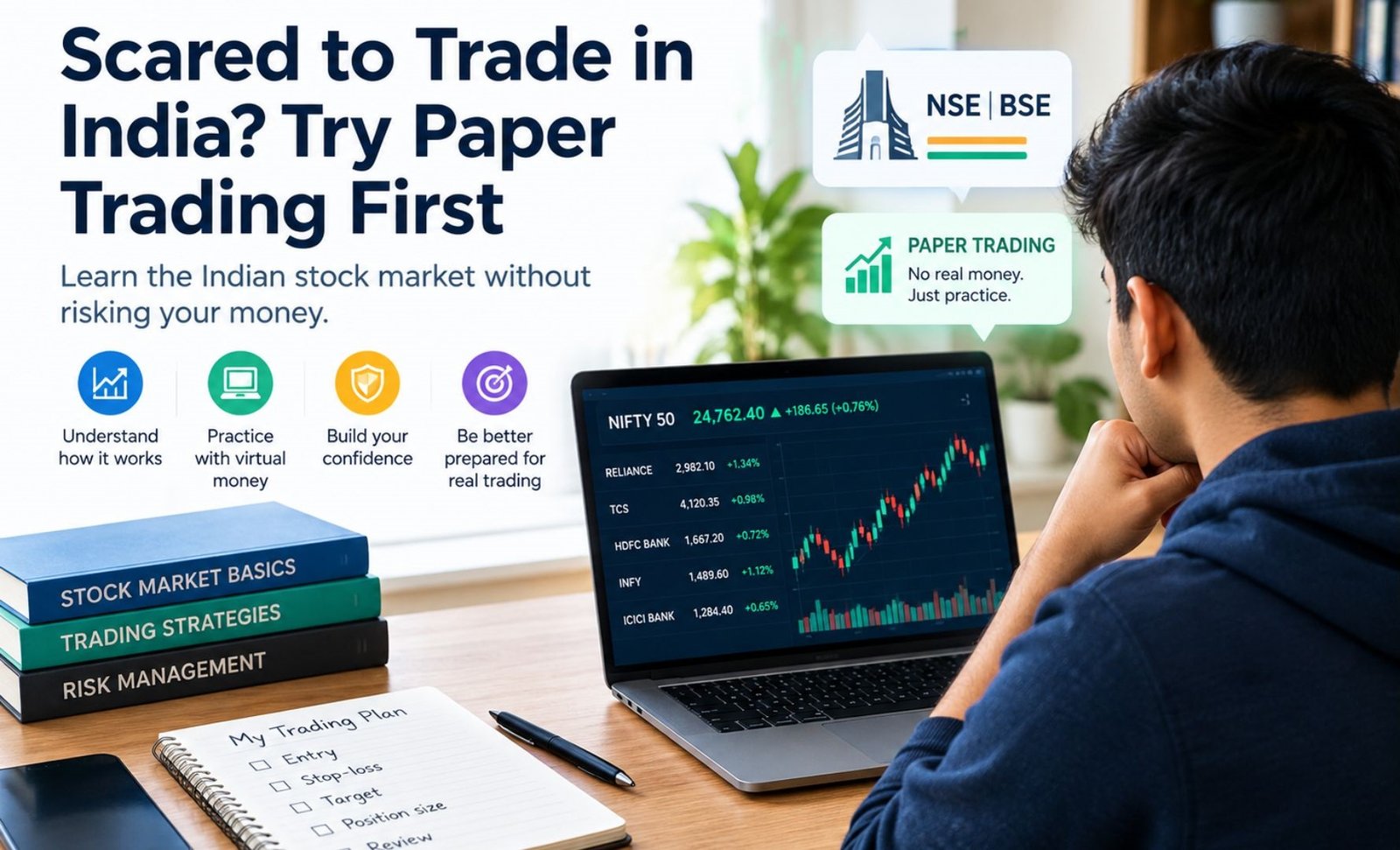
Scared to Trade in the Indian Stock Market? Try This First
Are you interested in the Indian stock market but afraid of losing money? You are not alone.
You may have watched NIFTY and Bank NIFTY charts, heard people talk about NSE, BSE, intraday trading, swing trading or options, and thought: “I want to learn this — but I don’t want my first mistake to cost me ₹5,000, ₹20,000 or more.”
That is exactly where paper trading or virtual trading can help.
Instead of putting your savings at risk immediately, you can practise making trades with virtual money. You can decide where to enter, how much to buy, where to place a stop-loss and when to exit — then see what would have happened.
If you are completely new to the Indian market and are nervous about losing money, do not rush into live trading. Start with structured paper or virtual trading for several weeks. For Indian-market practice, FrontPage’s Trade Lab is currently one of the more relevant choices because it is designed around Indian instruments and says it uses virtual capital with real-time market prices. Neostox is another simulator, but its current website says its market prices are delayed by 30 days. TradingView remains excellent for chart analysis, but its current help documentation says Indian-exchange symbols cannot be used in its Paper Trading simulator.
Inside This Story
- Why Are Beginners Afraid of the Indian Market?
- What Is Paper Trading?
- Paper Trading vs Virtual Trading: Are They Different?
- Which Is Better for a Beginner?
- Where Can You Practise Indian Stock Trading?
- FrontPage Trade Lab
- What About Neostox?
- Why TradingView Needs a Special Mention
- My Suggested 30-Day Beginner Method
- 5 Paper-Trading Mistakes to Avoid
- When Should You Move to Real Money?
- Frequently Asked Questions
Why Are Beginners Afraid of the Indian Market?
The fear is not necessarily a bad thing.
In fact, if you are new to trading and understand that your money can disappear quickly, that caution may protect you.
The problem starts when fear produces one of two extremes:
- You never learn because the market looks too complicated.
- You become confident after watching a few profitable trades on social media and start trading real money too quickly.
Neither approach is ideal.
The Indian market contains thousands of listed securities, multiple market segments and products ranging from simple equity investing to highly complex derivatives. NSE itself provides investor-education material covering subjects such as buying and selling shares, securities markets, derivatives and other market concepts.
For a beginner, the first objective should therefore not be “How quickly can I make money?”
A better question is:
That is where simulated trading becomes useful.
What Is Paper Trading?
Paper trading means practising trades without using real money.
Traditionally, a person could literally write down something like:
| Trade | Example |
|---|---|
| Stock | Reliance |
| Entry | ₹1,300 |
| Quantity | 10 shares |
| Stop-loss | ₹1,275 |
| Target | ₹1,350 |
If the price later reached ₹1,350, the theoretical profit would be ₹500. If it fell to ₹1,275, the theoretical loss would be ₹250.
Today, you do not need a notebook. Digital simulators can maintain virtual balances, positions, orders and profit/loss automatically.
The important part is this: the money is simulated, but your decision-making should be real.
Paper Trading vs Virtual Trading: Are They Different?
In everyday conversation, the terms paper trading, virtual trading, demo trading and stock market simulator are often used almost interchangeably.
There can be small differences between platforms, but for a beginner the bigger question is not the name.
The real question is:
What exactly does the simulator reproduce?
A useful simulator should allow you to practise things such as:
- Choosing an actual Indian stock or derivative.
- Deciding the quantity.
- Choosing an entry price.
- Using market or limit-style orders where supported.
- Setting a stop-loss.
- Setting a target.
- Tracking open and closed positions.
- Reviewing your trading history.
Even then, simulated trading cannot reproduce everything that happens with real money.
Which Is Better for a Beginner?
If you are asking, “Should I paper trade first or start virtual trading?”, my answer is simple:
You do not need to choose between the two as if they were completely separate activities.
Think of it this way:
| Method | Best Use |
|---|---|
| Notebook/manual paper trading | Learning discipline and trade planning |
| Virtual trading simulator | Practising order placement and trade management |
| Backtesting | Testing a historical strategy |
| Real trading | Only after sufficient preparation and risk control |
For someone who is completely new, I would actually combine the first two.
Plan the trade on paper → execute it virtually → record the result → review your decision.
That creates a much better learning loop than simply clicking Buy and Sell with fake money.
Where Can You Practise Indian Stock Trading?
This is where beginners need to be careful because many websites casually call themselves “paper trading platforms” without explaining exactly what market data or execution model they use.
As of September 2026, these are the options I would look at first for an Indian-market beginner.
| Platform | What It Is Useful For | Important Point |
|---|---|---|
| FrontPage Trade Lab | Indian stocks, F&O and virtual trading | Uses virtual capital and says it tracks real-time market prices |
| Neostox | Stocks, futures and options simulation | Current site says market prices are delayed by 30 days |
| TradingView | Excellent chart analysis and global paper trading | Indian exchange symbols are currently restricted from its Paper Trading simulator |
FrontPage Trade Lab: A Strong Starting Point for Indian Beginners
FrontPage is particularly interesting if your goal is specifically to practise the Indian market rather than simply learn charting.
Its current Trade Lab documentation says users can start with ₹10 lakh of virtual capital and practise equities, futures, options and commodities. It also says the system tracks instruments using real-time market prices and calculates virtual P&L as trades progress.
The current app listing also describes it as a paper-trading and virtual-trading platform for Indian stocks, options and F&O.
That makes it particularly interesting for a beginner who wants to learn the mechanics of Indian trading without immediately opening a real-money position.
There is another advantage: you can practise the process rather than merely watching charts.
For example, suppose you believe a stock will rise.
- Choose the stock.
- Decide your entry.
- Decide your quantity.
- Define your stop-loss before entering.
- Define your target.
- Place the virtual trade.
- Leave it alone according to your rules.
- Review the result later.
That is much closer to the decision-making process you will eventually face with real money.
What About Neostox?
Neostox is another Indian virtual-trading platform that offers simulated trading in stocks, futures and options. Its current website says users can practise with virtual money and provides features such as target/stop-loss, basket orders, options strategies and trading reports.
However, there is an important detail beginners should not miss.
Neostox’s current website states that market prices are delayed by 30 days.
That matters if your objective is intraday execution practice.
A delayed simulator can still be useful for learning the interface, understanding order mechanics or practising a strategy, but I would not automatically describe it as a substitute for live intraday market execution.
In other words, don’t choose a simulator simply because an article calls it “real-time.” Check the platform itself.
Why TradingView Needs a Special Mention
If you have watched trading videos on YouTube, you have probably heard of TradingView.
And yes, TradingView has a genuine Paper Trading feature. Its official documentation describes Paper Trading as a simulated account that lets users practise with virtual money and test strategies without deposits.
But there is a very important India-specific catch.
TradingView’s current help centre says that symbols listed on Indian exchanges cannot be used for Paper Trading, citing restrictions related to the NSE market-data usage policy.
So if your article is specifically about “How can an Indian beginner paper trade NSE/BSE stocks?”, simply recommending TradingView’s Paper Trading would be misleading.
TradingView is still extremely useful for charts, technical analysis, watchlists and market study. But do not confuse its charting capabilities with its current ability to simulate trades in Indian exchange-listed symbols.
My Suggested 30-Day Beginner Method
If you are genuinely interested in the Indian market but still afraid to lose money, don’t make your first goal “be profitable.”
Make your first goal be consistent.
Days 1–7: Learn the Market
Do not trade aggressively, even with virtual money.
Learn the difference between:
- NSE and BSE
- Equity delivery and intraday
- Market and limit orders
- Stop-loss and target
- Cash equity and derivatives
- NIFTY and individual stocks
- Profit/loss and risk per trade
NSE’s own investor-education resources are a useful starting point for understanding the securities market and trading basics.
Days 8–15: Take Only Planned Virtual Trades
Choose perhaps five to ten liquid stocks rather than jumping between dozens of names.
Before every virtual trade, write down:
- Why am I entering?
- Where am I wrong?
- Where is my stop-loss?
- Where will I exit if I am right?
- How much would I risk if this were real money?
Days 16–23: Stop Chasing Profits
This is where many beginners accidentally turn paper trading into a video game.
They receive ₹10 lakh virtual money and start buying everything.
That teaches the wrong lesson.
Instead, pretend the virtual money is your actual savings.
If you would never risk ₹50,000 of your real money on one trade, don’t casually risk ₹50,000 of virtual money just because nothing can be lost.
Days 24–30: Review the Numbers
At the end of the month, don’t ask only:
“How much profit did I make?”
Ask:
- How many trades did I take?
- How many followed my rules?
- How often did I move my stop-loss?
- How often did I chase a rising stock?
- How often did I enter because of someone else’s tip?
- What was my average win?
- What was my average loss?
- How large was my worst losing streak?
Those answers are much more valuable than a virtual ₹25,000 profit.
5 Paper-Trading Mistakes Beginners Should Avoid
1. Trading With Unlimited Fake Money
If your simulator gives you ₹10 lakh, don’t suddenly behave like you have ₹10 lakh in your bank account.
Use the amount you realistically expect to trade with.
2. Ignoring Brokerage and Trading Costs
A strategy that looks profitable before costs may become much less attractive after brokerage, taxes, exchange charges and other applicable costs.
Your simulator may not reproduce every real-world cost exactly, so keep a separate record when evaluating your results.
3. Trading Too Frequently
Fake money removes the pain of losing.
That can make you overtrade.
If your virtual account becomes a casino where you take 30 random trades a day, you are practising bad habits.
4. Believing a Virtual Win Proves You Are Ready
It does not.
Making money for two weeks in a simulator does not prove that you have a durable trading strategy.
Markets change. Volatility changes. Your behaviour changes when money becomes real.
5. Starting With Options Because They Look Exciting
NIFTY and Bank NIFTY options can look extremely attractive because a relatively small price movement can create a large percentage gain or loss.
That is precisely why beginners should be careful.
If you eventually want to trade options, practise them separately and learn how option price, time decay, volatility and position sizing affect the trade.
When Should You Move From Virtual to Real Money?
There is no magical number of days after which you are “ready.”
Instead, look for evidence of consistency.
You understand your setup → you follow your rules → you control position size → you accept losing trades → you keep records → and your results remain reasonably consistent over a meaningful sample of trades.
Even then, don’t jump from ₹0 real risk to ₹1 lakh.
A much safer transition is to use a very small amount of real capital and treat the first stage as another learning phase.
The purpose is not to prove that you can make money immediately.
The purpose is to discover how your behaviour changes when the ₹500 virtual loss becomes a real ₹500 loss.
Paper Trading Cannot Teach You Everything
This is perhaps the most important lesson in this entire article.
Paper trading can teach you:
- How to plan trades.
- How orders work.
- How to use stop-losses.
- How position sizing affects results.
- How a strategy behaves across multiple trades.
- How to maintain a trading journal.
But it cannot perfectly reproduce:
- Fear when your actual money is falling.
- Greed after a sudden profit.
- Hesitation before pressing the real Buy button.
- Slippage and execution differences.
- Liquidity problems in certain securities.
- The emotional pressure of a losing streak.
That is why paper trading should be considered training, not proof of future profits.
So, Should a Nervous Beginner Try the Indian Market?
Yes — but you don’t have to start by risking money.
If you are fascinated by the NSE/BSE market but feel nervous, that is actually a good reason to slow down rather than walk away.
Start by learning the basics.
Then use a proper Indian-market virtual trading platform.
Practise a small number of trades.
Keep a journal.
Review your mistakes.
And most importantly, don’t judge yourself by your virtual profit.
Judge yourself by whether you followed your own rules.
If you are completely new, start with virtual trading rather than real-money trading. For Indian-market practice, investigate FrontPage Trade Lab first and verify its current features/data before starting. Neostox is another option, but its current website says prices are delayed by 30 days. Use TradingView primarily for chart analysis unless its current Indian-market Paper Trading availability changes.
Frequently Asked Questions
Is paper trading safe for beginners?
Yes, in the sense that simulated trades do not put your actual trading capital at risk. But paper trading is not completely risk-free as a learning method: unrealistic assumptions, delayed data or careless virtual trading can create bad habits.
Is paper trading better than real trading for a beginner?
For someone who has no trading experience, paper trading is generally a sensible first step because it lets you learn the mechanics and test discipline without risking real capital. It should not be treated as a guarantee that you will make money later.
Which platform is best for paper trading in India?
There is no universal best platform. For Indian-market practice, FrontPage Trade Lab is currently worth considering because its documentation says it supports Indian equities and derivatives with virtual capital and real-time market prices. Neostox is another option, but its current website states that market prices are delayed by 30 days.
Can I paper trade NSE stocks?
Yes, some India-focused simulators provide virtual trading on NSE instruments. FrontPage’s Trade Lab documentation says it tracks NSE-listed equities and derivatives. However, TradingView currently restricts Indian exchange symbols from its own Paper Trading simulator.
Can I paper trade BSE stocks?
Availability depends on the simulator and its market-data arrangements. Do not assume that a platform supporting Indian charts automatically allows simulated trading on every BSE-listed security. Check the platform’s current instrument list before starting.
Does Zerodha offer a paper-trading account?
Zerodha currently says it does not offer demo accounts for paper trading, although it provides a demo version of Kite using dummy data.
How long should I paper trade before using real money?
There is no fixed number that works for everyone. Instead of relying only on a time period, build a meaningful sample of trades and demonstrate that you can follow your strategy, manage risk and accept losses without constantly changing your rules.
Can paper trading make me a profitable trader?
No simulator can make that promise. Paper trading can help you practise and identify weaknesses, but real-market performance depends on strategy, risk management, execution, market conditions and psychology.
Trusted References
Readers should verify platform features and market-data conditions directly because simulated-trading products can change over time.
- NSE India — Investor Education — official educational material covering securities markets, buying and selling shares and other investing concepts.
- TradingView — Paper Trading — official documentation explaining how its Paper Trading simulator works.
- TradingView — Indian Exchange Symbols and Paper Trading Restrictions — official explanation of why Indian exchange symbols are currently restricted in Paper Trading.
- FrontPage — Understanding Trade Lab — current documentation covering virtual capital, supported instruments and how simulated trades are calculated.
- Neostox — Paper Trading Platform — current platform information, including its stated market-data conditions and simulated-trading features.
Reviewed by The Knowledge Pulse Research Team
Disclosure: This article is for educational and informational purposes only. Paper trading and virtual trading do not guarantee future trading performance. Stock, futures and options trading involve significant risk, and readers should make decisions based on their own research and risk tolerance.
Conclusion
If you are sitting on the sidelines because the Indian stock market looks exciting but frightening, you don’t have to make your first move with real money.
Learn first. Simulate second. Risk real money later.
That may sound slower than jumping straight into NIFTY or individual stocks, but the objective of your first month should not be to become a trader overnight.
It should be to discover whether you can actually follow a trading process.
And that is something you can practise without losing a single rupee.