Trading Psychology: How Overconfidence and Revenge Trading Destroy Good Strategies
You can have a good strategy, a clean chart, a reliable indicator and a perfectly planned stop-loss — and still lose money because of one thing: your own decisions.
This is the uncomfortable side of trading that many beginners discover only after losing real money. Knowing what you should do and actually doing it when ₹10,000, ₹50,000 or ₹1 lakh is moving up and down on your screen are two very different skills.
One day you are confident because you have just made ₹8,000. The next day you are desperate to recover a ₹5,000 loss. In both situations, the market has not changed because of your previous trade — but your behaviour has.
That is where trading psychology becomes critical.
1. Why Trading Feels So Different From Normal Decisions
In normal life, most financial decisions do not change your money every few seconds.
Trading does.
You enter a position and immediately begin receiving feedback. The price moves up and you feel relief. It moves down and you feel tension. A position suddenly jumps into profit and excitement appears. A winning trade reverses and frustration follows.
This constant feedback can make traders react to the previous few minutes instead of following the plan they created before the market opened.
That is why a trader can understand technical analysis perfectly and still make poor decisions.
The problem is not always knowing what to do. Sometimes it is doing what you already know.
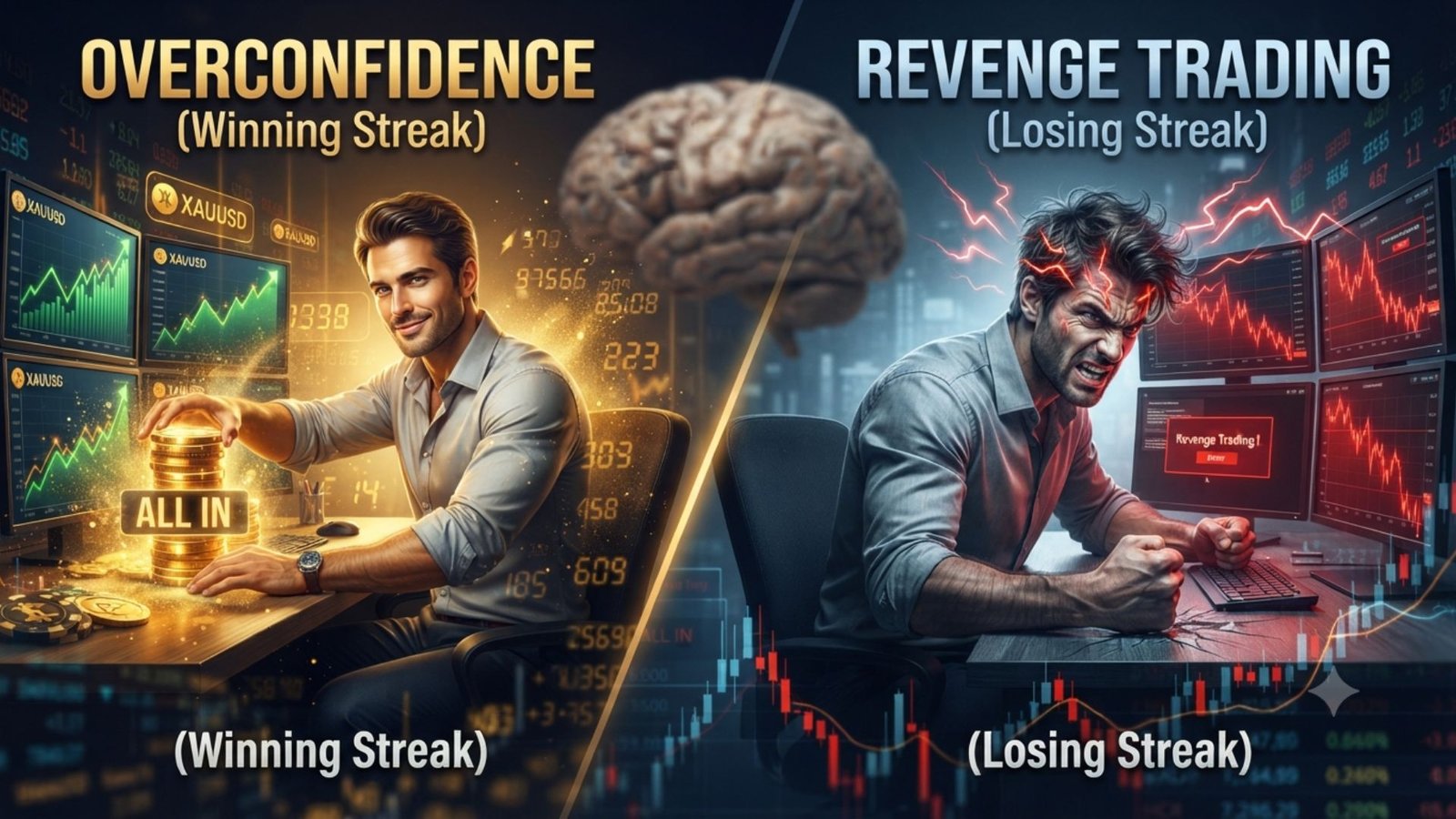
2. The Winning Streak Trap: When Confidence Becomes Overconfidence
Imagine you start your trading day with four successful trades.
A Simple ₹ Account Example
Trade 1: +₹2,000
Trade 2: +₹1,500
Trade 3: +₹2,800
Trade 4: +₹1,700
Total: +₹8,000
Now the fifth setup appears.
You normally risk ₹1,000, but you think:
“I am reading the market perfectly today. I’ll take a bigger position.”
Nothing about the fifth setup has automatically become safer because the first four trades were profitable.
But your confidence has changed.
This is where overconfidence can quietly enter the trading process.
You may start taking weaker setups, increasing position size or giving trades more room simply because recent results have made you feel unusually certain.
How Overconfidence Changes Trading Behaviour
- Position size increases after a winning streak.
- Entry rules become less strict.
- Stop-losses are moved because the trader feels certain about the direction.
- More trades are taken simply because the market “looks easy.”
- Risk management becomes less important after a profitable session.
⚠️ The Real Danger
The dangerous part of a winning streak is not winning. It is allowing those wins to change the behaviour that made disciplined trading possible in the first place.
How to Keep Confidence Under Control
Keep your risk rules independent of your recent performance.
If your normal position size is based on a fixed risk amount, do not suddenly double it because you are having a good day.
And remember one useful distinction:
A profitable trade is not automatically a good trade.
If you broke your rules and got lucky, the result does not make the decision repeatable.
3. The Losing Streak Trap: Revenge Trading
Now turn the situation around.
You lose ₹2,000.
Then ₹1,500.
Then another ₹2,500.
You are now down ₹6,000.
Instead of closing the platform, you think:
“I only need one big trade to recover everything.”
That thought is where revenge trading often begins.
The objective has changed.
You are no longer asking whether the next trade is a valid opportunity. You are trying to repair the previous trade’s damage.
How the Revenge Trading Loop Starts
🚨 The Dangerous Sequence
Loss → frustration → larger position → another loss → stronger frustration → even larger position.
One normal losing trade can therefore become a much larger problem if every subsequent decision is designed around recovering the previous loss.
The Right Question After a Loss
Do not immediately ask:
“How can I make this money back?”
Ask:
“Did I follow my trading plan?”
If you did, the loss may simply be one possible outcome of the strategy.
If you did not, the important lesson may be about your execution rather than the market.
4. Why Losing Money Feels So Personal
Behavioural finance research has documented loss aversion — the tendency for losses to have a stronger psychological impact than comparable gains in many decision-making situations.
For a trader, this can create a dangerous urge to act immediately after a loss.
But a loss does not create an obligation to place another trade.
💡 A Better Way to Think About a Loss
Instead of thinking, “The market took my money,” think: “This outcome was possible under my system. Did I execute correctly?”
5. Overconfidence vs. Revenge Trading
| Situation | Typical Thought | Possible Behaviour | Better Response |
|---|---|---|---|
| Winning streak | “I can’t lose today.” | Oversizing | Keep normal risk |
| Losing streak | “I need to recover it.” | Revenge trading | Pause and reassess |
| Missed move | “I must catch the next one.” | FOMO entry | Wait for a new setup |
| Disciplined state | “Does this meet my rules?” | Selective execution | Follow the plan |
6. The Trader’s Reset Button
You do not need to eliminate emotions to become a disciplined trader.
You need rules that prevent temporary emotions from controlling your next decision.
Guardrail #1: Define Your Maximum Risk
Before trading, decide how much you are prepared to risk on one trade and how much you are prepared to lose during the session.
The exact amount depends on your account size, strategy and personal risk tolerance. The important part is deciding it before emotions enter the picture.
Guardrail #2: Create a Loss Limit
A predefined daily loss limit can stop a bad session from turning into an emotional trading marathon.
Once that limit is reached, the trading day is over. There is nothing to recover immediately.
Guardrail #3: Separate Analysis From Execution
Before entering, know:
- What conditions must exist?
- What confirms the entry?
- Where is the invalidation point?
- How much are you risking?
- What would make you stay out?
If you answer these questions only after entering, emotion may already be influencing the decision.
Guardrail #4: Use a Trading Journal
A useful journal should record more than profit and loss.
- Why did I enter?
- Did the setup meet my rules?
- How much did I risk?
- Did I move my stop?
- How did I feel before entering?
- What did I do immediately after the trade?
After a few weeks, you may notice that your worst decisions happen after particular emotional triggers.
7. A 20-Second Pre-Trade Psychology Checklist
Before clicking Buy or Sell, stop for 20 seconds.
- Am I entering because my setup is actually present?
- Am I trying to recover a previous loss?
- Am I increasing size because I recently won?
- Where is my stop-loss?
- How much am I risking?
- Would I still take this trade if my previous trade had never happened?
One Question That Can Expose an Emotional Trade
“Would I take this exact trade if my last trade had produced the opposite result?”
If the answer is no, pause before entering.
8. The Goal Is Not to Win Every Trade
Many traders judge themselves after every position.
Win = good trader.
Loss = bad trader.
This mindset creates unnecessary pressure.
A better question is:
“Did I execute my process correctly?”
You can execute a valid setup, respect your risk and still lose.
You can also ignore your rules and make money.
Only one of those behaviours is worth repeating.
9. A Simple Weekly Psychology Review
At the end of each week, spend 15–20 minutes reviewing your decisions.
- Did I increase risk after winning?
- Did I increase risk after losing?
- Did I trade because of FOMO?
- Did I move a stop because I did not want to accept a loss?
- Which trade created the strongest emotional reaction?
- What mistake appeared more than once?
The purpose is not to criticize yourself. It is to discover patterns and build rules around them.
10. Trading Psychology Is Also Risk Management
Psychology is often treated as something mysterious — as though disciplined traders simply have stronger minds.
But many psychological problems become smaller when the trading structure becomes better.
If your position size is too large, every small price movement feels important.
If there is no daily loss limit, one bad trade can become five.
If your entry rules are vague, almost every chart can look like an opportunity.
Good risk management can therefore protect not only your account, but also your decision-making.
11. For Traders Who Trade Gold and XAUUSD
Not every reader trades Indian equities or index derivatives. Some traders focus on the global forex and metals market, particularly XAUUSD (Gold).
The psychological principles discussed in this article remain the same.
A trader who has just made $200 on Gold can become overconfident. A trader who has just lost $150 can become desperate to recover it. The currency changes, but the emotional pattern does not.
This is also where automated execution can have a role — not because software removes market risk, but because predefined rules can reduce the number of discretionary decisions a trader makes during fast-moving markets.
For XAUUSD Traders: ForexDevice
ForexDevice focuses specifically on automated trading technology for MetaTrader, with its GoldPulse PRO system designed around XAUUSD breakout execution, adaptive volatility calculations and predefined risk controls.
If you trade Gold and are interested in exploring a rules-based automated approach, you can review the system, its logic and its testing information separately from the psychology principles discussed here.
Explore ForexDeviceImportant: automation does not guarantee profits and does not remove market, execution or broker-related risks. Any automated strategy should be understood and tested before being used with real capital.
12. Conclusion: Your Last Trade Should Not Control Your Next
Trading psychology is not about becoming emotionless.
Fear, excitement, frustration and confidence are normal human reactions.
The objective is to stop those emotions from becoming the person making the trading decision.
After a winning streak, remember that the next trade is still another trade.
After a losing streak, remember that you do not have to recover the money immediately.
After missing a move, remember that you do not have to chase it.
And after making a mistake, examine your process before blaming the market.
🎯 The Mindset Shift
Stop asking: “How much can I make on this trade?”
Start asking: “Can I execute my plan correctly regardless of what happens next?”
You cannot control the next candle. You cannot control whether the next trade wins. You can control your preparation, your risk and your response.
External References & Further Reading
- Kahneman, D., & Tversky, A. (1979). Prospect Theory: An Analysis of Decision Under Risk . Econometrica, 47(2), 263–291.
- Investopedia. The Psychology of Forex Trading .
- American Psychological Association. Fearing Losses More Than Making Gains .